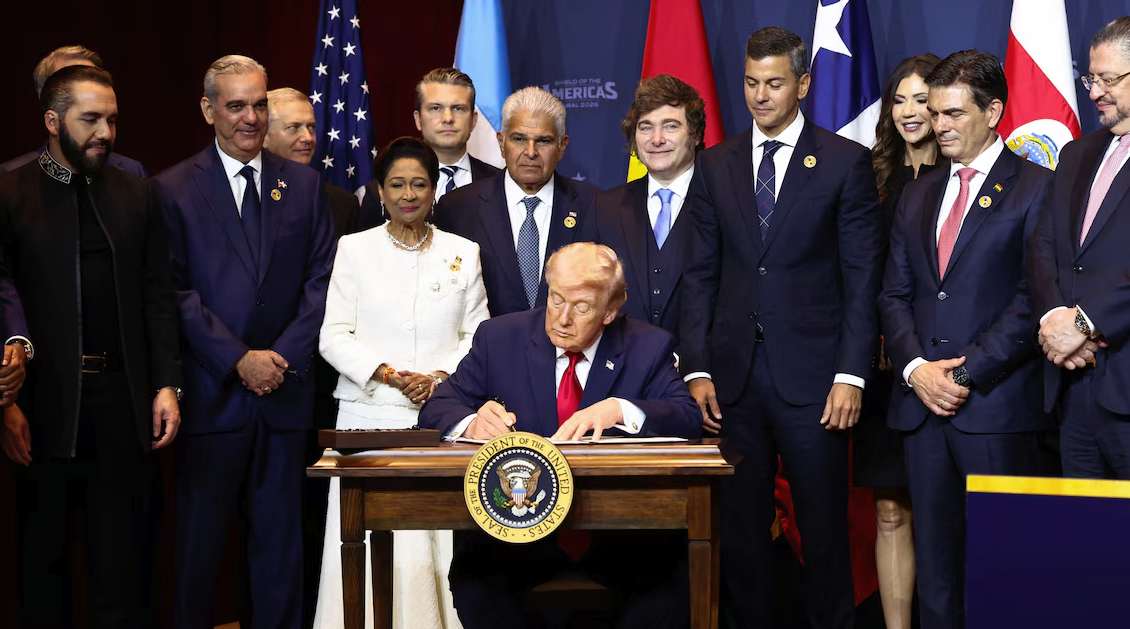
The Shield of the Americas summit in Miami was, in many respects, a familiar spectacle. President Trump reiterated well-worn themes: an iron fist against drug cartels, continued antagonism toward Cuba, and a justification of the Iran War. One detail stood out amid the familiar bombast: Trump’s visible pride in the endorsements he provided to right-wing figures across Latin America. Conditioning financial assistance to Milei’s victory was essential in Argentina’s last midterm election. The same occurred during the presidential elections in Chile and Honduras. As elections approach in Brazil, Colombia, and Peru, similar dynamics could emerge. The Shield of the Americas may prove less a security mechanism than a political franchise; a vehicle for exporting a particular brand of conservative politics southward, with Washington’s blessing.
Operationally, the initiative appears to be driven primarily by Secretary of State Marco Rubio and Defense Secretary Pete Hegseth. Both figures were vocal supporters of the recent joint operation targeting drug trafficking networks in Ecuador, being a precedent that should be examined with care. If the logic behind the Shield of the Americas is taken seriously and developed further, similar operations could follow under the guise of regional consensus. The question is: whose consensus? And to what end?

Here lies a fundamental and glaring contradiction at the heart of the Miami agenda. Mexico and Colombia—the two countries most directly affected by drug trafficking, the two nations whose cooperation would be indispensable for any genuine regional security architecture—were neither invited nor meaningfully included. Neither was Brazil. This is perhaps the most revealing absence of all. Brazil fields the largest and most capable military in Latin America, commands the continent’s biggest economy, and shares borders with ten of the twelve South American nations. Any serious regional security framework that does not include Brasília is not a framework, but rather a statement of ideological preferences. Argentinian political scientist Juan Carlos Puig argued decades ago that countries like Argentina and Brazil should not aspire to full-scale alignment with a hegemon, but autonomy—the capacity to act in the international system without succumbing to external coercion. Lula’s Brazil has embodied exactly this: what Puig called heterodox autonomy, maintaining an open dialogue with Washington while systematically diversifying partnerships across the Global South. That posture, apparently, is disqualifying in Miami.
Trump’s Donroe Doctrine is pushing some Latin American leaders to diversify their international strategies toward Africa, Asia, and the Middle East, precisely to reduce dependency on a volatile White House. However, the Miami attendees seem to prefer the US protectorate status. Moreover, the Shield of the Americas resembles less a comprehensive security mechanism and more a political club. Much like Trump’s Board of Peace, it is unlikely to address the structural drivers of drug trafficking: poverty, institutional weakness, limited economic alternatives for rural populations, and the insatiable demand for narcotics in the US itself. Security summits that exclude the most affected parties and foreground ideology over pragmatism do not produce lasting results. They produce photo opportunities.
One additional signal deserves attention. Despite expectations, China did not appear as a central priority at the Miami gathering, perhaps because of Trump’s forthcoming visit to Beijing. The Panama Canal was mentioned, predictably, but a comprehensive confrontation with Chinese influence across Latin America was notably absent. This is telling. The Shield of the Americas, for all its martial rhetoric, may ultimately be less about containing China than about reshaping Latin America’s domestic political landscape in Washington’s image.
By framing regional security through an ideological lens and excluding key actors, the Trump administration is likely accelerating precisely the South-South diversification it claims to oppose. As Latin American governments watch Washington impose its political preferences on regional security architecture, the appeal of BRICS membership, expanded ties with China (as seen with Uruguay), and commercial partnerships with the Middle East, can grow stronger. Dependency on a volatile hegemon has always been the most powerful recruiter for autonomy.
The lesson from decades of Latin American foreign policy is precisely the opposite of what Miami prescribed. ‘Pink Tide’ governments of Lula, Kirchner, and Chávez—whatever their domestic shortcomings—understood that autonomy in a multipolar world is earned through diversification, not alignment. That is the foreign policy tradition Latin America should be drawing on: one built on sovereign agency, South-South solidarity, and the pragmatic broadening of the region’s international portfolio. The Shield of the Americas offers instead a return to the Monroe (now Donroe) Doctrine’s logic: the region as a protectorate, its security defined and managed from Washington. Latin America tried that model. It did not work.
Autor

PhD candidate at UNU-CRIS and Ghent University. Master's degree in Latin American Studies from Georgetown University and a Master's degree in Diplomacy and International Relations from the Diplomatic School of Spain.