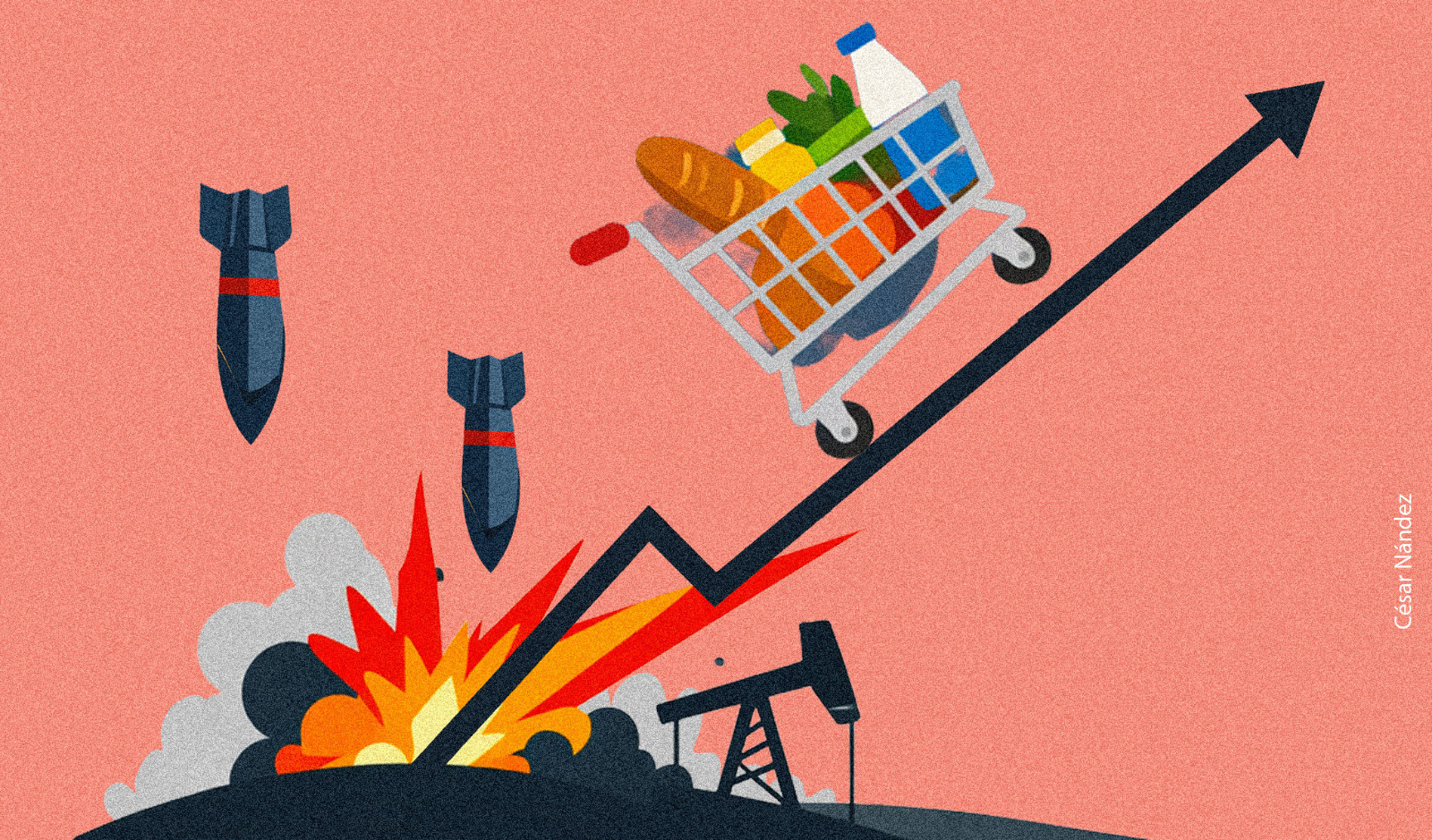
The impact of the war in Iran on Latin America, despite appearances and distance, is and will be significant. The conflict, with its epicenter in Western Asia and ramifications across the globe, carries considerable potential for instability for our region.
The absence of real “Strategic Autonomy” in our region multiplies risks and reduces room for maneuver. Our governments, despite appearances, are compelled to submit to the authority of the dollar. Any deviation that fails to comply with unwritten systemic rules can end up being paid for through capital flight, currency depreciation, or higher inflation. Moreover, when oil prices surge, our fiscal gaps widen and our external debt burdens worsen.

Why can such a distant war affect us so much?
The conflict that erupted on February 28 in Iran is a complex asymmetric war. There are far more actors behind the scenes than formal combatants on the ground. In Western Asia bombs fall, but the chess game is played on a global board.
What is currently at stake is not only control of the Strait of Hormuz or the continuity of Iran’s nuclear program. Like it or not, it is about the United States’ capacity to sustain three major pillars of its hegemony: energy, logistics, and monetary power. It is, therefore, a war of attrition in which what is at stake is nothing less than the global governance system under which we have operated for decades.
Within this framework, Iran is not seeking a conventional military victory but rather to push U.S. military presence away from its surroundings and erode Washington’s influence as durably as possible. And here again, the problem for our countries is that their stability (financial, but also political) depends on an umbilical cord called the dollar, in which oil prices are denominated and through which goods and services are imported.
The drama of budgets
A key element that helps clarify matters is that our countries draft their budgets each year based on an estimate of the average price that Brent crude will have in the following year. When, in 2025, the governments of Colombia, Brazil, and Mexico prepared their budgets for 2026, they worked with different assumptions: Colombia expected oil to hover around $60 per barrel; Brazil, $65; and Mexico, $70.
Brent, however, surpassed $100 on March 11, and based on what has been seen so far (on the battlefield, in the markets, and in foreign ministries), it does not appear likely to return soon to the $60–70 per barrel range.
That gap is dramatic. The difference between the real price and the one calculated by our governments last year is called inflation. Or, more specifically, “inflationary pressures”: transport, fertilizers, freight—everything quickly becomes more expensive and ends up impacting the price structure, affecting households’ purchasing power and, ultimately, the stability of our countries.
Inflation and risk zones
Inflation is key in our system: in practice, it functions as a governance mechanism. With very few exceptions, it assigns to the “market” the capacity to determine who will continue to access goods and who will have to give up buying; which companies will survive and which will end up growing—taking advantage of their competitors’ bankruptcies. In Latin America, inflation operates as a technical and silent mechanism for reorganizing power relations and inequalities.
In the current context, there are Latin American countries that may end up faring very poorly as a consequence of the global disruption caused by the Iran War. Colombia, Ecuador, Chile, Uruguay, Paraguay, and Panama, even if they have little or no direct relationship with that distant country, are characterized by significant external exposure—both in imports and exports—and this carries a cost that is paid in dollars and can be very high.
Catalogue of specific cases
Mexico, in this context, is almost an exception. On the one hand, it produces and exports oil but imports gasoline. Moreover, it cannot fully take advantage of the upward cycle because it cannot scale up production overnight. However, it hedges its oil price each year—which provides invaluable financial coverage—and uses extraordinary revenues to finance subsidies that prevent gasoline price increases from feeding into inflation. This combination makes it less vulnerable than others.
The rest, faced with a disruptive event like the war in Iran, will tend to suffer. It is not only about having oil or being prudent; it is also about structural vulnerabilities, which are paid for dearly. Many of the countries mentioned above will experience the situation with particular severity due to their lack of productive diversification, their manufacturing shortcomings, and the aforementioned external exposure, which is no minor issue.
A particular case in Latin America is that of the major agro-exporting countries of South America. There, the shortage or rising global price of fertilizers—which are not produced locally in significant quantities and have increased by 30% since late February—will make it harder to maintain costs, productivity, and profits.
The rise in this input, essential for improving crop yields, ends up being passed on to the food basket and forms part of the “inflationary tensions” that our region projects onto other parts of the world, thus affecting global food security. What happens in Western Asia therefore has a major impact on Latin America, but also on the rest of the world, and especially on the Global South—the weakest link in a fragile and asymmetric “world order.”
In conclusion
What ultimately becomes clear, beyond calculations and forecasts, is that what is most worrying for our region are the impacts that this situation is already beginning to produce: interest rates that punish the productive economy; a silent increase in inequality; intensification of irregular migration and organized crime; environmental degradation; and, as a foreseeable corollary, external interference.
The enduring vicious circles that hinder our strategic autonomy and compromise our regional development are, in short, reinforced by a distant war that deepens our fragilities. It is not necessary for a single Latin American soldier to be in the Persian Gulf for a financial (and political) bomb with delayed effects to have fallen on our dollarized economies. And the worst news is that there is no shield capable of stopping it.
Autor

Associate Professor at the Latin American Institute of Economics, Society and Politics, UNILA (Brazil). PHd in Sociology from the École des Hautes Études en Sciences Sociales - EHESS (Paris).