Recently, the crisis of political representation has exposed the weaknesses of political parties in Peru. Against this backdrop, it is concerning that many of them have opted to select candidates through delegates. While this mechanism is not inherently undemocratic, in practice it has become distorted in Peru by being used mainly by personalistic parties, where it functions as a filter that concentrates power in a few hands and reduces the real participation of party members. Can a system in which a few decide for everyone be considered democratic?
The short answer is that, although it is legally valid under the Law on Political Organizations, in terms of social legitimacy, selection by delegates represents a step backward. While under the closed model—known as “one member, one vote”—all eligible members on the party rolls have the right to directly choose the candidates, under the delegate model the final decision falls to a very small group that, in some cases, does not even represent 0.1% of the total membership. This disproportion is not merely a logistical coincidence, but rather a dynamic that facilitates control over the process.

As political scientist Fernando Tuesta Soldevilla points out, this mechanism functions as a “funnel” that stifles renewal. When decision-making power is transferred from thousands of citizens to a small circle, the possibility of dissent disappears. In Peru, this has in practice helped consolidate the so-called “rent-a-party” organizations, where there is no competition of ideas, but rather a staged performance to ratify decisions made “by handpick.”
If we examine the evidence from the primary elections held ahead of the 2026 General Elections, the delegate model no longer appears to be an exceptional alternative, but rather the rule. Of the 39 participating political organizations, 37 resorted to it, while only two directly selected their candidates through a vote by their members. Existing regulations also establish no minimum ratio between the number of delegates and the number of party members, allowing membership rolls of thousands of people to end up being represented by small groups, without any reasonable proportion between the size of the membership and the number of people making the final decision.
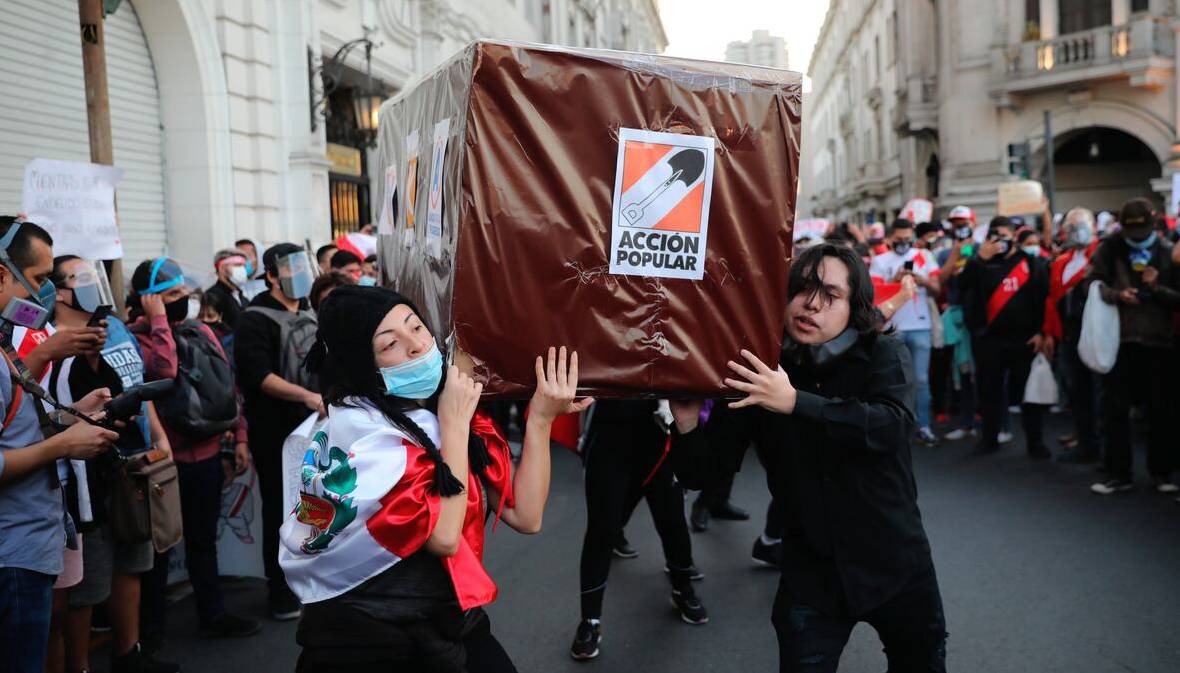
The most significant case was that of Acción Popular, a historic mass party with more than 230,000 members and a territorial presence throughout the country. Despite its size, the final decision on its candidates was left in the hands of just 73 delegates. Although the party had presented six presidential lists and displayed one of the highest levels of internal competition in the process, its primaries were declared null and void because of irregularities in the list of delegates. Since the corresponding stage had already expired in the electoral calendar, it was not possible to call a new election, and Acción Popular was therefore excluded from the 2026 General Elections.
Although this party was not excluded because of the delegate model itself, but rather because of substantial irregularities found in the formation of the list of delegates, the case demonstrates the fragility of this mechanism for a mass party. When this chain of intermediation failed, the grassroots had no way to correct the outcome through their direct vote. The “funnel” not only reduced their participation, but ultimately eliminated it altogether.
The risk increases in organizations whose structure revolves around personalistic leadership, where delegates may end up ratifying appointments that have already been made. A striking example is Fuerza y Libertad, where three people represented more than 60,000 members. Although this figure alone does not demonstrate that decisions were imposed, it does reveal a structure that is easily controlled and has little capacity to challenge decisions.
We cannot fail to mention Fuerza Popular, the organization that won the General Elections and currently leads the government. It may be understandable that the presidential candidacy went to Keiko Fujimori, as the party’s main leader. However, its 104 delegates did not decide solely on the presidential ticket, but also on the candidates for the Senate and the Chamber of Deputies. Moreover, 37.5% of them resided in Lima, while the central region of the country accounts for just 7.7%. The problem, then, goes beyond the presidential candidacy, since a small group concentrated in the capital determined parliamentary candidacies throughout the country.
This concentration of power has direct consequences for the crisis of representation. Citizens perceive political parties as “private clubs” with their doors tightly shut. By limiting the real participation of their members, organizations lose their role as channels between the state and society. Moreover, the delegate system becomes a breeding ground for a lack of transparency. It is easier for pressure groups, economic interests, or party leaderships to influence a handful of people than to secure the support of thousands of members.
Oversight by the National Office of Electoral Processes (ONPE) and the National Jury of Elections (JNE) should not be limited to the formalistic exercise of verifying records and deadlines either. The Acción Popular case demonstrated that the legitimacy of the outcome depends on the entire preceding chain, from the way delegates were selected to their official proclamation and the consistency of the information submitted to the electoral authorities. It is not enough to supervise the final moment of voting if the representation arriving at the ballot box has been called into question from the outset.
The “delegates’ club” must open its doors. As long as a few people continue deciding on behalf of tens or hundreds of thousands of members, we will continue to have candidates without roots, parties without purpose, and citizens who look with disdain at processes that, under the name of “internal democracy,” are nothing more than simulations of participation. Genuine political reform begins by restoring the vote to party members and taking power away from party elites. Only then can we begin to close the gap of distrust that today separates Peruvians from those who claim to represent them.
Autor

District Secretary General of Lince for Popular Action, a political party in Peru. Law graduate with training in electoral law, electoral processes, and governance. Recipient of a scholarship for political training programs from the Konrad Adenauer Foundation.