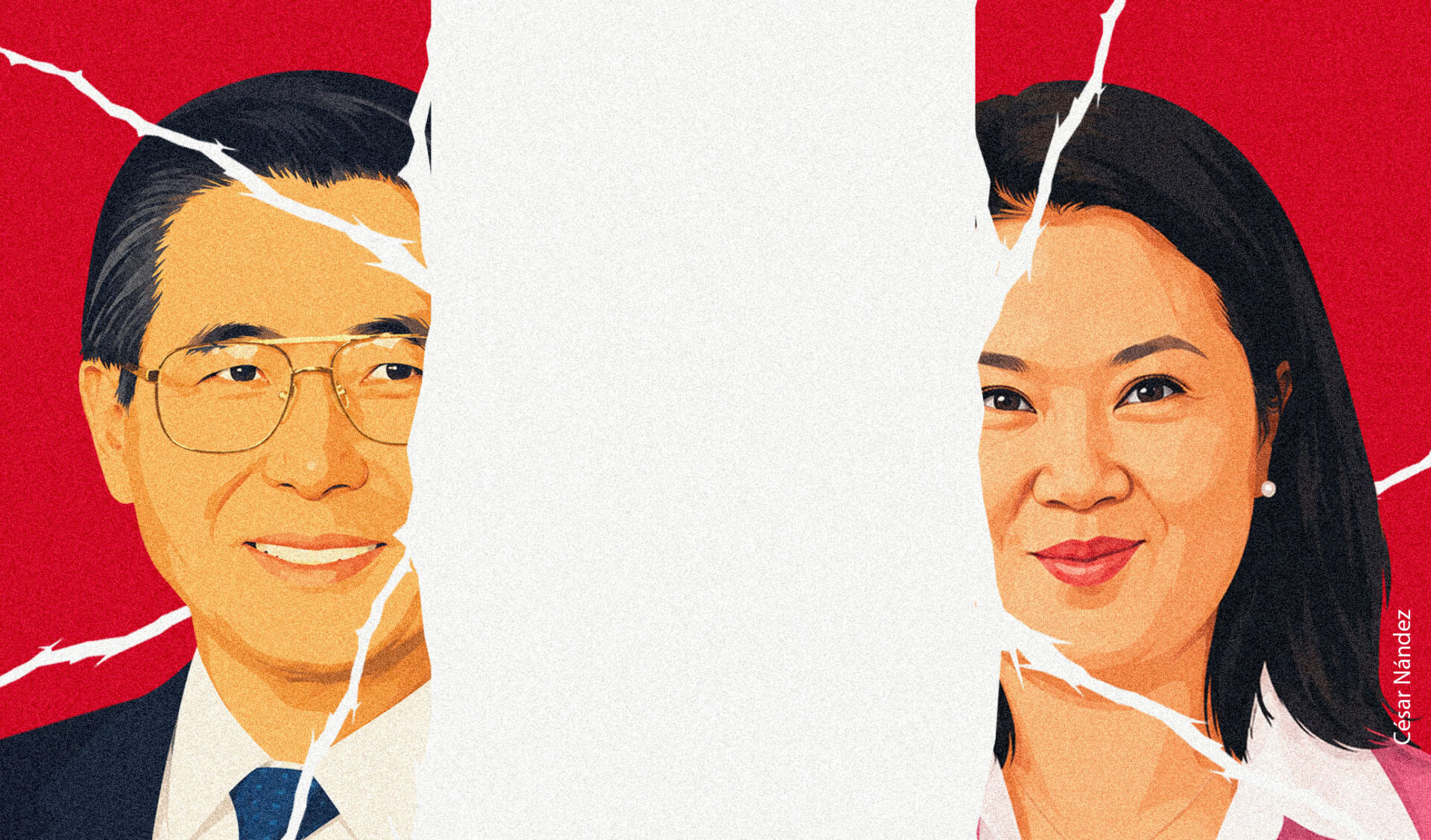
Keiko Fujimori has won. At last. After three consecutive defeats, the daughter of the dictator has finally crossed the finish line. But not with an overwhelming victory: a mere 49,641 votes, just 0.2%, separated the Fuerza Popular candidate from left-wing contender Roberto Sánchez.
The first round had already painted a bleak picture: a country fragmented into dozens of rootless political parties, a disillusioned citizenry that views politics with indifference, and a political class that has made improvisation and the absence of a coherent project its defining feature. None of this was new. The question now is: how will Keiko govern Peru over the next five years?

A decade of misrule
The 2026 victory cannot be understood without looking back. For ten years, Peru became a laboratory of democratic decay. Keiko lost in 2016 and, instead of accepting defeat, her party claimed electoral fraud and sought to delegitimize Pedro Pablo Kuczynski’s government. In 2018, the Fujimorist-controlled Congress forced his resignation. In 2020, Martín Vizcarra was removed from office on the grounds of “moral incapacity.” In 2021, Keiko lost again—to Pedro Castillo—and once again refused to recognize the outcome.
Castillo’s presidency was disastrous: chaotic, plagued by allegations of corruption, and cornered by a hostile Congress. His failed self-coup in December 2022 and subsequent arrest paved the way for Dina Boluarte, a weak president who governed under the tutelage of Keiko Fujimori and her broad parliamentary coalition, suppressing protests and violating human rights. By 2026, the message had taken hold: democracy had become synonymous with disorder. Only a strong hand could restore order.
“Govern like my father”
During the campaign, on April 27, in a low-income neighborhood of Lima, Keiko declared: “I want to be president to govern as my father did.” It was neither a metaphor nor an emotional concession. She was announcing a governing program, a promise to replicate the model of the 1990s: order, authority and economic efficiency. And also—though she does not say it explicitly—authoritarianism, corruption and human rights violations.
Yet there is a crucial difference between father and daughter. Alberto Fujimori emerged in 1990 as an outsider. He challenged the political establishment, implemented a shock economic program, dismantled the Shining Path insurgency, and governed against the traditional elites. Keiko, by contrast, comes to power with the backing of the mainstream media, economic elites and conservative forces that once opposed her father. She is not a transformative force. She is a reactive, transactional one. Her restoration is not a founding project—it is the illusion of returning to the past.
An empty restoration
What Keiko Fujimori offers is neither innovation nor rupture. It is the repetition of a formula that already failed. Her father’s regime collapsed amid scandal and his flight to Japan. Philosopher Cornelius Castoriadis described this as “the rise of insignificance”: hyperactive societies overloaded with information and deeply polarized, yet incapable of generating new ideas. Electoral campaigns became little more than repetitions of empty formulas.
Peru in 2026 faces a climate crisis, structural informality, digital transformation, migration, and demands for cultural recognition. Yet the Fujimorist proposal offers no answers to these challenges. It simply invokes the memory of a past that no longer exists.
The restoration led by Keiko Fujimori has revealing historical parallels. The first is the Bourbon Restoration in Spain (1874–1931). Alfonso XII—the son of Queen Isabella II, who had been deposed in 1868—was not an innovator but a restorer who allied himself with the Church, the military and conservative elites to reestablish the monarchy. A managed alternation between two political parties ensured formal stability for decades, but at the cost of hollowing out politics and repressing dissent. Eventually, the accumulated tensions became unsustainable: first with Primo de Rivera’s coup in 1923, then with the proclamation of the Second Republic in 1931.
The second example is South Korea under former President Park Geun-hye (2013–2017). Her father, Park Chung-hee, was a transformative dictator who drove rapid industrialization before being assassinated by his own intelligence chief in 1979. His daughter presented herself as the heir to his legacy, backed by the same conglomerates and conservative forces that had once resisted her father. The outcome is well known: corruption, influence-peddling, and a shadow government run by an unelected confidante. Park Geun-hye was ultimately impeached, convicted and imprisoned.
The trajectories of both the Spanish and South Korean restorations foreshadow the central tension of Fujimorism 2.0: when nostalgia for a transformative past becomes the basis for political restoration, it risks hardening into a rigid, hollow and fragile formula.
Congress as a political apparatus
Keiko Fujimori does not take office in an institutional vacuum. She arrives after a Congress—dominated for years by her party—constructed what Michel Foucault called a dispositif: a strategic network of heterogeneous elements—laws, institutions, appointments, political discourse and administrative measures—articulated to reshape the balance of political power, redefine state structures, and establish the conditions for the Fujimorist restoration.
What did this apparatus accomplish? It captured the branches of government and independent institutions. This was neither accidental nor simultaneous. It was a carefully orchestrated strategy, thread by thread, law by law. A protective web was woven around Fujimorism while systematically dismantling institutional checks and balances.
At the same time, Congress changed the electoral rules to fragment the opposition vote, lowering the requirements for registering new political parties and thereby encouraging vote dispersion that would benefit Keiko Fujimori and Fuerza Popular.
The results of this electoral engineering reveal a striking distortion. For the Chamber of Deputies, Fuerza Popular received just 14.7% of the valid vote, yet secured 41 of the 130 seats (31.5%). In the Senate, the pattern was similar: 15.1% of the vote translated into 22 of the 60 seats (36.7%). With less than one-seventh of the vote in each chamber, Fujimorism now controls more than one-third of the Senate and nearly one-third of the Chamber of Deputies. This institutional apparatus effectively transformed a minority into a parliamentary majority.
Yet every apparatus contains the seeds of its own vulnerabilities. An opposition coalition made up of Juntos por el Perú (32 deputies), the Partido Cívico Obras (14), and Ahora Nación (10) holds a combined 56 seats in the Chamber of Deputies. While short of the 66 votes required for an absolute majority, it remains strong enough to censure ministers, block key initiatives, and force negotiations. Ironically, the constitutional reforms designed to weaken institutional checks may also become tools for the new legislative opposition to challenge Keiko’s government.
The fragility of restoration
To secure its survival, Fujimorism is already resorting to its familiar playbook of political co-optation. Its first move is to fracture the newly formed opposition bloc. It is doing so through methods it knows well: bribes, appointments for relatives, and the allocation of public works contracts. The goal is to entice the most vulnerable legislators, whether motivated by financial ambition or burdened by pending judicial cases. Peru’s recent congressional history is full of lawmakers who switched parties. Parliamentary corruption is not the exception—it is the rule.
The second strategy is subtler but equally effective: negotiating with the new center-right bloc represented by the Buen Gobierno party, whose leader and former presidential candidate Jorge Nieto is expected to receive what, in mafia jargon, is known as “an offer he can’t refuse.” If either of these maneuvers succeeds, Fujimorism could secure absolute majorities in both chambers, effectively neutralizing any meaningful oversight or legislative resistance.
Yet even if it manages to rebuild artificial majorities, the Fujimorist restoration remains vulnerable to tensions that cannot be resolved within parliamentary politics alone.
The first is the generational divide. Peruvian society in 2026 is not the Peru of 1990. For younger generations who have grown up amid precarity and distrust, a new political order marked by violence and impunity could deepen the existing crisis of legitimacy.
The second is the economic contradiction. Alberto Fujimori’s economic model—privatization, extreme deregulation and labor market flexibilization—no longer commands the same consensus or delivers the same results as it did two decades ago. Dependence on commodity prices, the climate crisis and the limits of extractivism pose challenges that cannot be solved with the old policy recipe.
The third is the shadow of the South Korean experience. Personalist restoration governments are especially vulnerable to corruption scandals because they lack a strong programmatic legitimacy and rely on opaque patronage networks. Fujimorism’s history is replete with such episodes: the Cocktails case, illegal campaign financing, ties to Vladimiro Montesinos, and later connections with individuals accused of drug trafficking and other even more serious crimes.
The future remains an open question
Keiko Fujimori’s victory in 2026 is not merely another democratic alternation in power. It is a restoration project that, under the banner of nostalgia for a lost order, has emptied Peruvian democracy of its substance and reduced it to the repetition of formulas that have already proven to be historical failures. No new ideas have emerged—only the selective reassembly of fragments from the past to impose a closed vision of the future.
History, however, is neither mechanical nor predetermined. The future remains an open question, not an echo of the past.
Autor

Professor and researcher at the Center for Research in Social Sciences and Humanities of the Autonomous University of the State of Mexico. Former President of the Mexican Association of Political Science (AMECIP). PhD from FLACSO-Mexico.