There is a meme that has been circulating on social media for weeks: a world map divided into three major spheres of influence led by China, Russia, and the United States. The map neatly encapsulates an increasingly widespread feeling: that relations between countries are no longer based on clear rules or multilateral consensus, but are instead subject to the baton of strong, authoritarian leaders who are ever less willing to be held accountable—and that relevant decisions are being made ever farther from the spaces where democratic oversight operates. In light of this scenario, one question arises: how should democracies respond when the world is reorganizing without them?
The path toward normalizing this new international scenario has a direct and negative effect on the functioning of democracy. Even the most deeply rooted democracies in Latin America and Europe are witnessing the rise of authoritarian leadership that find legitimacy in an environment increasingly tolerant of power concentration and the absence of checks. Discourses abound that reject the separation of powers, question the value of civil rights, or portray institutional counterweights as obstacles to achieving security policies or economic growth. This shift narrows the horizon of available democratic alternatives by imposing increasingly restricted decision-making logics in which governing with limits appears as a disadvantage compared to those who promise efficiency without oversight.
When these narratives are embraced on a global scale, the room for their reproduction at the domestic level also expands, weakening countries’ capacity to impose limits and defend shared rules. Democracies thus face the challenge of offering credible alternatives before these authoritarian drifts consolidate as viable electoral options with an international backing they previously lacked.
In an international scenario increasingly marked by imposition and unilateralism, various governments and multilateral spaces in these two regions have already begun to craft responses. The International Economic Forum Latin America and the Caribbean 2026, recently held in Panama City, reflected this attempt to recover regional coordination in the face of external interference directly affecting political and economic stability. Along the same lines, the renewed momentum in negotiations between the European Union and Mercosur, as well as the free trade agreement reached between the European Union and India, point toward diversifying ties and expanding decision-making margins in response to the aggressive tariff policy of the Trump administration.
“Variable geometry” was the term used by the Canadian Prime Minister in Davos to refer to this effort by middle powers to seek alliances among different countries and groups of countries based on their collective needs and interests. Beyond trade strategy, these initiatives express a shared need for protection in a context of high uncertainty in which power increasingly appears to operate without clear rules beyond the law of the strongest.
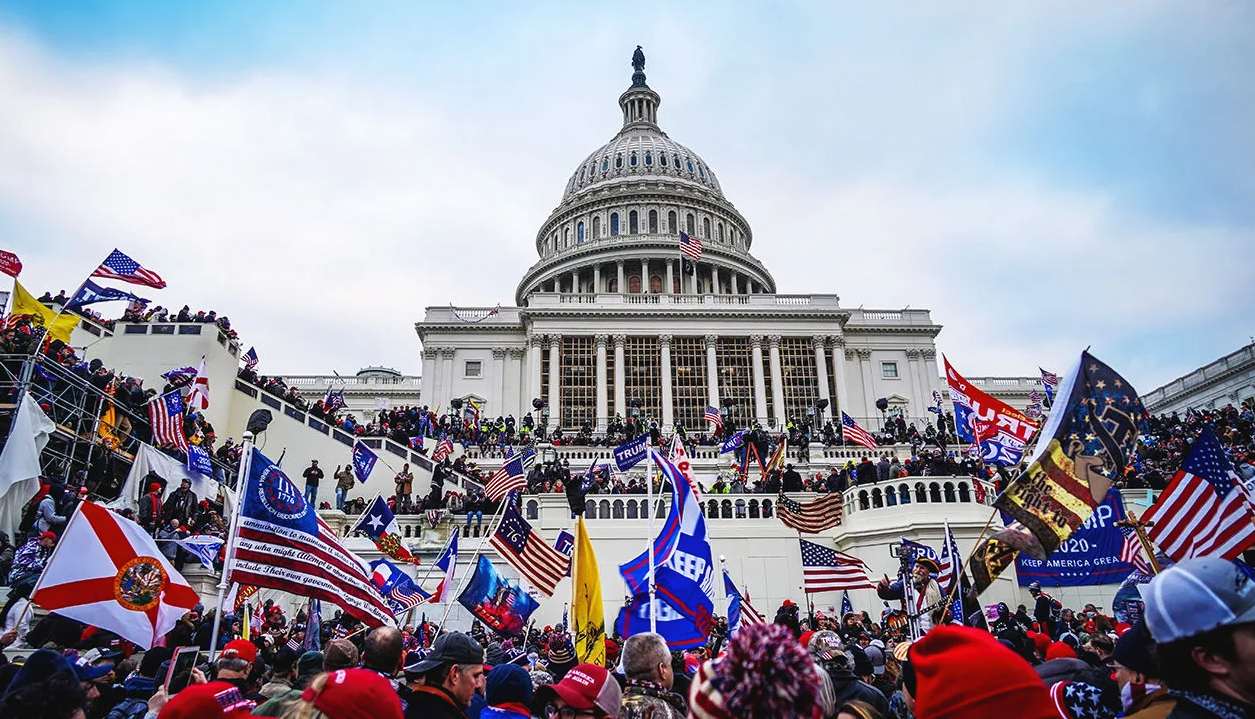
However, democracies cannot react only at the institutional level to shield themselves from these authoritarian blows. When democracy is perceived as being under attack, citizen mobilization emerges as a defensive reaction, with the evident advantage of immediacy and visibility in drawing red lines.
In Brazil in 2022 and Guatemala in 2023, citizens mobilized to defend the electoral result against attempts to overturn it. In Argentina, citizens mobilized against the 2024 “Ley de Bases” promoted by the Milei government, and in Mexico in 2025 against the election of the judiciary. In January of this year, thousands of people mobilized in Nuuk and Copenhagen to reject Trump’s intention to take Greenland by force, thereby sweeping aside the democratic principle of self-determination. In an international context increasingly tolerant of the discretionary use of power, democratic citizens are capable of—and willing to—react when they perceive that democracy is at risk of backsliding, as these recent years have shown.
When the world is reorganized according to authoritarian logics, democracies must defend themselves jointly and with all the tools at their disposal. What is at stake is the capacity to sustain a democratic defense over time in the face of external and internal pressures that tend to reinforce one another. That defense requires coordinated action combining institutions capable of cooperating, negotiating, and setting limits with a vigilant citizenry ready to raise the alarm in the face of episodes of democratic erosion.
When these two dimensions fail to connect—when institutions act without the backing of citizens, or when mobilization lacks institutional support—backsliding advances more easily. Today, Latin America and Europe have the opportunity to build a common space from which to offer a solid democratic alternative to the abyss suggested by the meme of the world map.
Autor

PhD candidate at the Complutense University of Madrid and member of the Network of Women Political Scientists and the research project "Changes within democracies: setbacks, resistance and resilience" at the National Autonomous University of Mexico. Master's degree in Comparative Politics from the London School of Economics and Political Science.