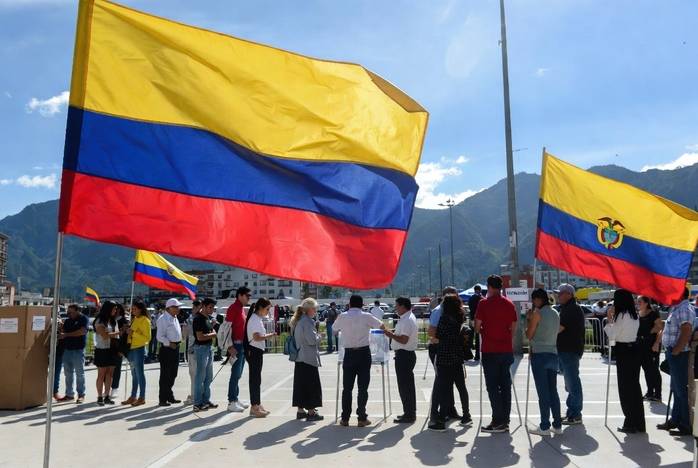
As Colombia enters the final week of campaigning before the first round of the presidential election, the country is awash in hostility. From acts of violence, such as the murder of members of Abelardo de la Espriella’s campaign team and the vandalism of campaign offices belonging to Paloma Valencia and Iván Cepeda, to the rhetoric of the candidates themselves and their countless surrogates, aggression has become the currency of exchange. It is as if the only way to attract attention in a world dominated by algorithms is to inflame people’s emotions, appeal to their lowest instincts, portray one’s opponent as a deplorable enemy, and seek the eradication of opposing ideas—at least on a moral level. This raises an important question: once the electoral smoke clears, what kind of country will remain to be governed?
There has been no genuine deliberation. Beyond the absence of debates, candidates have preferred speaking in spaces where there are no follow-up questions and no exposure to alternative viewpoints that would at least merit listening to and considering. References to rival campaigns have largely taken the form of confrontation and personal attacks. Adding to this dynamic, and with considerable enthusiasm, are the President of the Republic and several cabinet ministers. Despite restrictions on political participation by government officials, members of the administration have repeatedly cited opposition posts and used stigmatizing language against opposing candidacies, making it abundantly clear who the preferred candidate of the Casa de Nariño is.

Nor has the opposition offered many examples of decency or respectful conduct. Some have framed the democratic process as a “spiritual war,” promoted the notion that this would be the last free election if the government-backed candidate wins, and even turned against one another with accusations of crimes and misconduct. Policy proposals are scarce when the primary objective is maximizing social media engagement. Reading the X accounts of the leading campaign strategists, for instance, is like entering a nest of disinformation, manipulation, and messages designed to convince citizens that the country stands on the brink of catastrophe. There is no room for moderation, nuanced positions, or diagnoses that recognize that reality requires multiple perspectives to be properly understood.
We are therefore witnessing an election dominated by spectacle, memes, and anger. The problem is that these hate-driven narratives gradually erode the collective understanding that Colombia is a shared national project, and that citizens who think differently are not enemies but people with whom we must coexist. The concept of the “enemy” is easily distorted and serves to make people fear difference and reject the possibility of dialogue and compromise. The romanticization of social protest when it turns into vandalism creates a troubling tolerance for the destruction of campaign spaces, while the response increasingly promotes the idea that the only solution is a heavy-handed approach that sweeps aside citizens’ rights.
The supposed moral superiority claimed by one side over another, far from representing elevated political discourse, is simply another way of creating false dichotomies between good and evil, where those who vote differently are portrayed as morally deficient citizens. Amid so much aggression, what will happen once a new occupant arrives at the Casa de Nariño and half the country feels excluded?
*Text originally published in the newspaper El Espectador, Colombia.
Machine translation, proofread by Ricardo Aceves.
Autor

Director of the newspaper El Espectador. Winner of the Simón Bolívar National Journalism Prize. Master's degree in Journalism with a focus on Newspaper Management from Northwestern University. He holds a degree in Philosophy from the University of Los Andes in Bogotá.