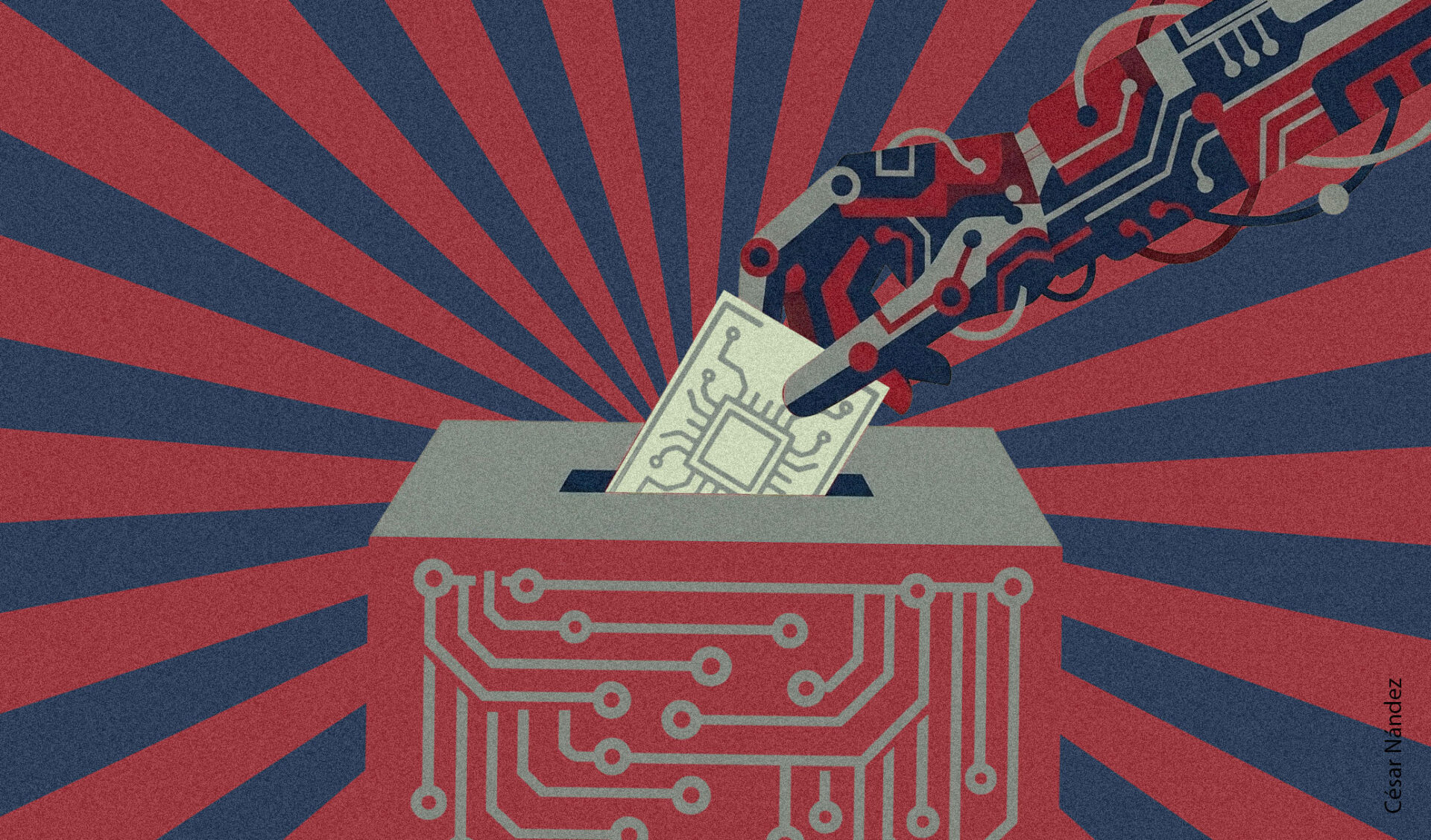
There is a question that should unsettle any democrat, regardless of political affiliation: what does it mean that the unjustified challenge to electoral results is no longer the cry of a desperate loser, but rather the rhetorical instrument of sitting presidents, leaders with millions of followers, and governments that, instead of providing certainty, erode institutions from within? Something has changed. And what has changed is not the technology.
President Gustavo Petro has cast doubt on the technology used by Colombia’s National Civil Registry (RNEC) throughout the electoral campaign. Specifically, he has pointed to the alleged opacity of the source code of Colombia’s vote-counting software as evidence of electoral manipulation. The gesture itself was not new: electoral technology was once again being portrayed as opaque and inaccessible. What was less familiar was the source of the accusation. It did not come from the opposition, but from the Casa de Nariño. Not from someone competing against the government, but from the person leading it.

Electoral software has an extraordinary quality for anyone seeking to discredit it: its technical complexity creates an asymmetry of understanding that always favors the accuser. Claiming that the source code has been manipulated is easy, takes only seconds, and requires no evidence whatsoever. Refuting such a claim demands weeks of technical analysis, external audit reports, and communicators capable of translating computer science into language accessible to the public. By the time the rebuttal arrives, the narrative has already taken hold.
This principle—that a seeded doubt does not need to be proven—is the backbone of every technological fraud narrative. The objective is not to prove anything. It is to generate enough distrust so that any unfavorable result—or even one that is not—can be interpreted as evidence of conspiracy. Electoral authorities are then forced to defend their own innocence instead of serving as guarantors of the process.
What makes the Petro case particularly relevant is not its uniqueness but precisely the opposite: its place within a pattern that spans the ideological spectrum from one extreme to the other. The technological fraud narrative belongs to no single ideology.
In 2020, Donald Trump built one of the most thoroughly documented episodes of electoral disinformation in recent history around a central premise: that machines produced by Dominion Voting Systems and Smartmatic had been manipulated to reverse the election outcome. The claim was rejected by more than sixty courts, by his own Department of Justice, and by independent auditors in the contested states. It is not unreasonable to regard the fraud narrative as a catalytic element behind the January 6, 2021 attack on the U.S. Capitol, leaving millions of citizens convinced that an algorithm had stolen their vote.
Jair Bolsonaro took the argument even further by questioning the integrity of Brazil’s electronic voting machines—a system that had operated for decades without documented incidents and had delivered his own previous electoral victories. The very technology that had made him president became, once he lost, the technology that had betrayed him.
Petro stands at the ideological opposite of Trump and Bolsonaro, yet the fraud narrative cuts across ideological divides. It is the hallmark of a political strategy that works regardless of who employs it.
Beyond any specific episode, these narratives inflict institutional damage measured in years or even decades, not weeks. The first and most obvious consequence is the erosion of trust in electoral democracy as a legitimate mechanism for the peaceful transfer of power.
The second consequence is less visible but equally serious: it makes it harder to modernize electoral systems in the future. If the source code is considered suspicious today, it will remain so tomorrow. If electronic voting machines are deemed fraudulent whenever defeat occurs, electoral authorities will have progressively less room to introduce technological innovations that could enhance transparency, accessibility, and efficiency.
The third consequence is the normalization of refusing to recognize electoral outcomes as a politically viable option. Every time a prominent leader challenges a result without evidence and without repercussions, the threshold for doing so falls even lower.
In recent years, concrete judicial precedents have emerged demonstrating that democracies can, when they possess the institutional will, impose real consequences on those who spread baseless fraud narratives.
The first and most significant of these precedents is the case of Jair Bolsonaro in Brazil. In June 2023, the Superior Electoral Court barred him from holding public office until 2030 after he convened dozens of foreign ambassadors at an official meeting—broadcast on public television—to cast unfounded doubt on the integrity of the country’s electronic voting system. The court found that the former president had committed an “abuse of political power” and had deliberately disseminated “violent rhetoric and lies” that placed “the credibility of electoral justice at risk.”
The second precedent is of a different nature but equally revealing: the case of Fox News versus Dominion Voting Systems in the United States. Following the 2020 election, Fox News actively promoted the narrative that Dominion’s machines had been manipulated to alter the outcome in favor of Joe Biden. Dominion sued the network for defamation, seeking $1.6 billion in damages. The proceedings uncovered something even more disturbing than the disinformation itself: internal messages showed that Fox hosts and executives themselves acknowledged the fraud claims were false, yet continued to broadcast them for commercial reasons in order to retain viewers. In April 2023, the Delaware Superior Court ruled that none of Fox News’ statements about Dominion were true. Faced with the prospect of a trial that would expose this internal hypocrisy, the network agreed to pay $787 million to settle the case before it reached the courtroom.
These two cases point in the same direction. The first line of institutional response must be to ensure that impunity is not the norm. When technological fraud narratives can be spread without legal, political, or reputational costs, they become a free political resource. When they carry tangible consequences, the calculation changes.
Colombia will need to adopt measures that make the cost of disinformation high enough for political actors to think twice before resorting to it.
Autor

Executive Director of Transparencia Electoral. Degree in International Relations from Universidad Central de Venezuela (UCV). Candidate for a Master's Degree in Electoral Studies at Universidad Nacional de San Martín (UNSAM / Argentina).