In 2009, an Indigenous girl from the Yepamahsã people, also known as the Tukano, suffered a snakebite near her community in the Upper Rio Negro Indigenous Territory, in northwestern Brazilian Amazonia. Her case could have remained a medical file, but it ultimately raised a much broader question: what does it mean to guarantee the right to health when life, illness, and healing are understood through a cultural framework different from the Western one?
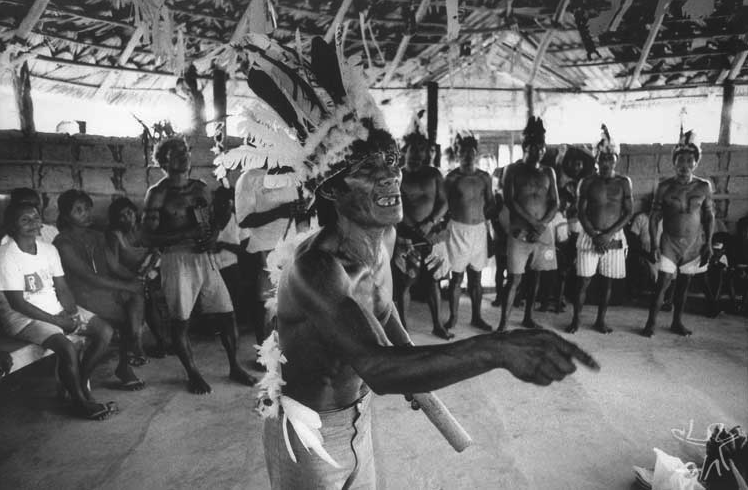
The girl, identified as L.T.B., received treatment in a context where Indigenous traditional medicine and Western medicine do not always interact on equal terms. For the Yepamahsã people, the practice of bahsese forms part of a distinct system of knowledge about the body, illness, territory, and relationships with other beings. The concept refers to sacred verbal formulas or chants used by traditional healers to activate healing, protect communities, and purify food. It is not a folkloric addition or a secondary belief, but rather a form of care.

At the heart of the claim is the demand that the Brazilian state guarantee the right to health without prejudice or discriminatory practices. This means recognizing that Indigenous peoples possess their own systems of care and traditional healing methods that cannot be ignored by public policies.
When caring for people also means caring for the territory
In many Amazonian communities, caring for a person cannot be separated from the river, the forest, the animals, ecological cycles, or the spiritual relationships that organize collective life. Health is not limited to hospital care or access to medicines. It also depends on keeping the territory alive and ensuring that local knowledge is respected.
This perspective is often absent from public policy and reflects a longstanding tension across the region: the difficulty Latin American states face in recognizing Indigenous forms of care that do not separate the body from the territory. Even where Indigenous health systems exist, as in Brazil, the gap between legal frameworks and everyday practice remains significant. The challenge is not only one of resources but also of recognition. Too often, the state provides care without understanding the cultural universe in which that care should acquire meaning.
From Manaus to the Inter-American Court
The Human Rights and Environmental Law Clinic of the State University of Amazonas decided to bring this discussion before the Inter-American Human Rights System. From Manaus, the clinic prepared written observations and participated in the public hearing of the Inter-American Court of Human Rights concerning the scope and content of the right to care, a consultation requested by Argentina. Its contribution was to incorporate an Amazonian and intercultural perspective, demonstrating that, for Indigenous peoples, care cannot be separated from territory, collective health, and traditional knowledge.
The clinic did not arrive at this debate by chance. Established in 2010, it trains law students through real-world cases and works with communities whose rights are often threatened by environmental degradation. Over time, it became part of national and international networks, including the Alliance of Environmental Law Clinics of Latin America and the Caribbean, created in 2019 to strengthen environmental legal education and the defense of environmental and human rights across the region.
In March 2024, two law students from the university, Isabella Benchaya da Silva and Luciana Valois Coelho da Silva, traveled from Manaus to San José, Costa Rica, to appear before the Inter-American Court. Joining them was Yupuri João Paulo Lima Barreto, an Indigenous anthropologist from the Yepamahsã people. Their intervention drew the attention of Judge Verónica Gómez, who requested further details about Tukano care practices.
The scene carried significant symbolic weight. A public Amazonian university brought before a regional court a question born in the forest: how can rights be protected when traditional legal categories are insufficient to describe Indigenous ways of life?
The right to care is not neutral
The advisory opinion on the right to care emerged from a broad debate. Yet, as often happens, there was a risk that the discussion would remain centered on the experiences of urban and majority populations. Who provides care? Who receives it? What obligations do states have? These are necessary questions, but they are insufficient if Indigenous realities are excluded.
The clinic proposed expanding the framework. Care cannot be understood solely as a relationship between people. In Indigenous contexts, it also encompasses relationships with the environment. This idea has practical implications. If a river is polluted, a forest destroyed, or a health policy dismisses traditional knowledge, the right to care is weakened. Not because a legal provision is missing, but because the web of relationships that sustains daily life is disrupted.
The forest also produces law
In 2025, the Inter-American Court issued Advisory Opinion OC-31/25. In it, the Court recognized that states must adopt measures to prevent, mitigate, and remedy environmental harm, not only as an environmental objective but also as a condition for guaranteeing other rights, including the right to care.
The Court also stated that public policies must recognize different models of care organization and value traditional, local, and Indigenous knowledge systems. In particular, it highlighted approaches that connect the care of people with the care of the environment. What had long been defended in territories such as the Upper Rio Negro entered the language of regional law: caring for people can also mean caring for rivers, forests, animals, and other non-human beings.
The experience of the State University of Amazonas clinic demonstrates something that Latin America should pay closer attention to: law is not produced only in capitals or major courts. It is also shaped by public universities on the frontier and by Indigenous communities that compel us to rethink seemingly settled legal categories.
The intervention before the Inter-American Court was a way of bringing Amazonian voices into a space where standards for the entire continent are defined. It was also a formative experience for students who discovered that a legal clinic can influence high-level regional debates without losing its connection to the territory.
At a time of environmental crisis, this connection is essential. Human rights can no longer be treated as if they float above ecosystems. In the Amazon, health depends on territory. Care depends on the forest. And justice begins by listening to those who have spent generations sustaining ways of life that the law is only now beginning to recognize.
This article is part of the compendium “Environmental Law Clinics in Latin America and the Caribbean: Education, Territory, and Environmental Justice,” published in May 2026 by the Peruvian Society for Environmental Law, the Alliance of Environmental Law Clinics of Latin America and the Caribbean, and Latinoamérica21.
Machine translation, proofread by Ricardo Aceves.