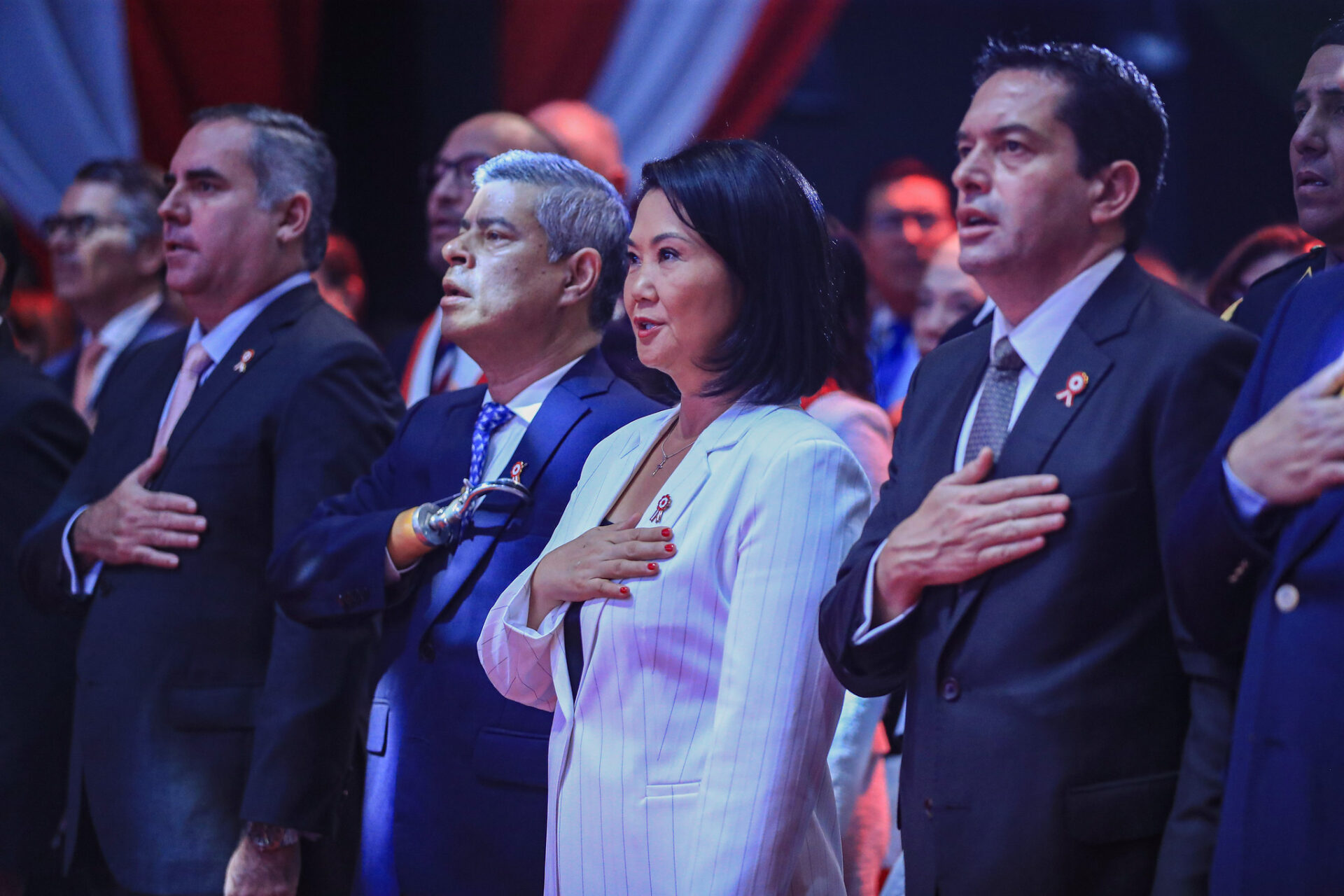
During the inauguration ceremony of Keiko Fujimori as president of Peru on July 28, there were protests in the streets of Lima’s historic center, several of them led by Roberto Sánchez, the losing candidate in the runoff election. Some lawmakers from his party, Juntos por el Perú, as well as from Ahora Nación, both opposition parties, walked out of the chamber, while others wore black mourning ribbons and turned their backs as Fujimori delivered her address to the nation.
In Colombia, outgoing President Gustavo Petro has refused to recognize the electoral victory of Abelardo de la Espriella as the new president, alleging fraud without evidence. Even Iván Cepeda, the losing candidate from his party, has acknowledged the victory. Nevertheless, Petro’s refusal has permeated the media and public opinion, affecting the legitimacy of the incoming president. What do these kinds of behaviors imply? What are their effects on the stability of democracies?

The loser’s consensus, a pillar of democracy
The loser’s consensus is a central component of the functioning of democracies, particularly in presidential systems under conditions of fair competition. To the extent that losing contenders recognize the victory of elected presidents, they complement the legitimacy of origin that winners obtain through most of the votes. In the United States, for example, there is a practice of the losing candidate delivering a “concession speech” to their supporters, usually preceded by a phone call to the winning candidate. This is the expected behavior when the difference between the winner and the loser is substantial, but sometimes, when the results are very close and the losing candidate does not accept defeat, contentious situations arise.
Obviously, protesting and refusing to accept the results are politically understandable when there is clear evidence of fraud, as happened with Venezuela’s presidential elections in 2024. But when there is no such evidence, the absence of the loser’s consensus tends to create far-reaching problems, and in the contemporary era, it is a factor that increases negative polarization. There are several cases of sore losers in the history of presidential elections, but in the 21st century, emblematic episodes of the absence of the loser’s consensus have gone from being mere anecdotes to becoming the source of serious institutional crises. The most emblematic cases are Mexico in 2006 with López Obrador, the United States with Donald Trump in 2020–2021, and Brazil with Jair Bolsonaro in 2022–2023.
From Mexico to the Capitol riot
López Obrador lost the presidential election of July 2, 2006, to Felipe Calderón by a margin of just 0.56%. He did not accept the defeat and raised the banner of fraud: for nearly a month and a half, his party and supporters occupied the Zócalo and one of Mexico City’s main avenues as a means of pressuring the electoral authorities. The peak of his rejection of the results came on November 20, when he staged an inauguration ceremony as “legitimate president” before his supporters in the same Zócalo, even wearing a presidential sash and appointing a cabinet. Although the mobilizations he led were not violent, they did generate social discontent and, in the long run, prompted legal reforms that restricted the executive branch’s influence over elections—paradoxically, reforms that he himself did not respect when he became president between 2018 and 2024.
Donald Trump did not recognize Joe Biden’s victory in the U.S. presidential election of November 3, 2020, despite the fact that the result exceeded a 4% margin in the popular vote and 74 electoral votes. The refusal to accept the results continued in the following weeks and culminated in an incendiary speech by Trump that prompted his supporters to storm the Capitol on January 6, 2021, as the majority of electoral votes in Biden’s favor was being certified. The result was at least five deaths, hundreds of injuries, and an increase in the extreme polarization that still persists in U.S. politics.
A similar event was the storming of the Plaza of the Three Powers in Brasília on January 8, 2023, as a result of Bolsonaro’s refusal to accept the results of the October 2022 presidential election, which gave the victory to Luiz Inácio Lula da Silva. The protests devolved into acts of vandalism and resulted in more than 1,500 arrests.
The lasting effects of rejecting electoral results
Although all three cases were ultimately resolved through institutional channels, their effects persist in the political dynamics of these countries. The case of Bolivia, with Evo Morales in 2019, should also be added, as his fraudulent election triggered violence across the country. The fraud was set in motion in 2016, when citizens rejected Morales’s reelection in a referendum, but the Constitutional Court, co-opted by his movement, subsequently allowed him to run for office again. When the similarly co-opted electoral body decided to award him the victory in 2019, polarization ultimately triggered mobilizations that left hundreds injured and several people dead in Sacaba and Senkata.
Accepting defeat fosters a politics of cooperation and reduces polarization. When the “loser’s consensus” is absent, formal mechanisms can contain its negative effects, but if this absence develops in contexts of weakened institutions and high polarization—which tends to increase during electoral campaigns—then it becomes a mechanism capable of triggering post-election violence.
Personalist leadership and weakened parties
In the cases discussed above, those who refused to accept defeat were incumbent presidents, with the exception of López Obrador. They emerged from and lead loosely structured political movements, without a clear ideology and therefore easily manipulated through rhetoric; this control allows them to act directly on their supporters’ behavior, and for that reason they are responsible for the negative consequences for democratic stability.
“Traditional” parties can hardly prevent this dynamic, as happened with the Republican Party in the United States, or they are so institutionally weak that they operate only according to a vertical logic in which the leader’s wishes matter more than preserving the principles of democracy, as happened with Bolivia’s MAS, Brazil’s Liberal Party, or Mexico’s now-defunct Party of the Democratic Revolution.
The loser’s consensus is a necessary condition not only for the legitimacy of new governments but also for the stability of political systems and the continuity of democracy. It should therefore be a concern for citizens as well, and not only for political elites.
Autor

Political Scientist. Professor at the University of Guanajuato (México). PhD. in Political Science from the University of Florence (Italy). His areas of interest are politics and elections in Latin America and modern political theory.