John Reed, an American journalist, poet, and activist, arrived in Mexico in 1913 as a war correspondent for the New York-based magazine Metropolitan Magazine. He accompanied Pancho Villa in the battles in La Laguna against federal forces and returned to his country a few months later. In 1917, he set off for Petrograd to witness the final stages of what came to be known as the October Revolution. He would write two memorable books based on these experiences: Insurgent mexico and Ten days that shook the world. The title of this article is drawn from the latter work.
In Mexico, Zapatismo, inspired by anarchist principles, championed the slogan “land and liberty.” In still-tsarist Russia, Lenin would proclaim, years later, the propagandistic maxim “All power to the Soviets.”

More than 100 years have passed since those historic moments. Today, Mexico is under the second government of the so-called Fourth Transformation, while Russia is governed by Vladimir Putin, “the man without a face,” as Moscow-based journalist Masha Gessen called him.
López Obrador came to power in 2018 after winning the election, campaigning on the slogan of transformation and invoking the symbols of independence from Spain, liberal reform, and the Mexican Revolution. He quickly struck a chord with millions of Mexicans.
Once in power, he had to move from rallies in public squares to the politics of the National Palace. He needed to lay the foundations for his administration to ensure that his political movement would retain power. From day one, he decided to set in motion a change in the political regime that would be carried forward by President Claudia Sheinbaum.
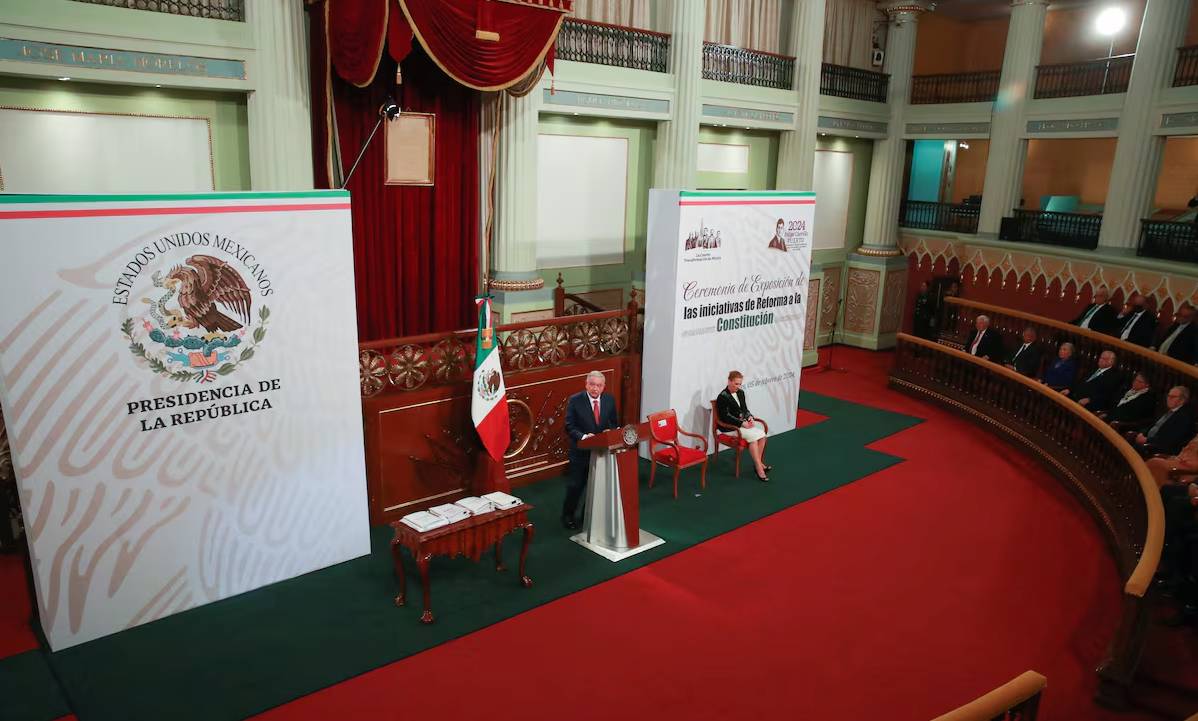
What are these ten constitutional reforms that have transformed the architecture of the democratic transition painstakingly built by political leaders over the past 40 years and altered the distribution of power, institutional checks and balances, security, and the rules of political competition?
First, judicial reform, approved in September 2025, institutionalized the popular election of judges, magistrates, and Supreme Court justices, as well as the creation of the Judicial Disciplinary Tribunal and the judicial administration body. The underlying issue is that the reform entails a shift from the question of “who governs” to the legal question of “who controls those who govern.”
Second, the so-called administrative simplification of seven autonomous constitutional bodies, approved in December 2024, amended various articles of the Constitution and eliminated references to what had been one of the “crown jewels” of the democratic transition. The problem was not simply the disappearance of certain institutions, but who would take over their functions going forward and to whom they would be accountable.
Third, constitutional review, popularly known as “constitutional unchallengeability” or “constitutional supremacy.” This October 2024 reform is particularly regressive because it affects the mechanism through which decisions made by the Congress of the Union can be challenged. In other words, whatever the Congress amends will be unappealable, even before the Supreme Court of Justice of the Nation.
Fourth, military power. In 2019, the National Guard was created under civilian command, and various constitutional articles were amended to enable it to operate and help address the serious security problems arising from the advance of organized crime.
Fifth, in September 2024, a reform was approved placing the National Guard under military oversight. The significance of this reform is qualitative: the National Guard was initially designed to operate under civilian command but ultimately came under military command, altering the constitutional distribution of responsibilities between civilian and military authorities and expanding the powers of the latter.
Sixth, the state’s punitive power. The so-called mandatory pretrial detention measure, approved in December 2024, expands the list of crimes subject to this provision. Technically, this amounts to an expansion of political power, not only over institutions but also over the coercive capacity of the Mexican state.
Seventh, economic power. The constitutional reforms of October 2024 strengthened the state’s role in certain strategic areas, with the aim of bolstering its economic power. The stated objective is thus to rhetorically restore central power to the state, a move that entails greater concentration of power.
Eighth, the constitutional changes of April 2025 concerning the rules governing the reproduction of political elites, related to non-reelection and nepotism, will shape the continuation, renewal, or obstruction of political elites beginning with the electoral processes of 2030.
Ninth, direct democracy. In December 2019, then-President López Obrador submitted a proposal on the recall of the president to the Congress of the Union. This is not a matter of weakening an institutional check and balance, but rather of changing the relationship between citizens and the executive branch.
And tenth, political-military control. In October 2025, the Senate’s powers concerning the senior ranks of the National Guard were adjusted in relation to certain positions within this national security institution.
Between 2018 and 2026, the change of regime has brought about five significant institutional shifts: from judicial oversight to the new judicial model; from autonomous bodies to institutions dependent on the executive branch; from constitutional review to shielding constitutional reforms from challenge; from civilian predominance to a greater military presence at the center of power; and from a regulatory state to a greater concentration of economic and punitive power.
If John Reed were alive, he would surely be surprised to discover that those early popular revolutions ultimately shook the world through a high degree of personalization and militarization of power.
Autor

Professor at the Universidad Autónoma de Sinaloa. D. in Political Science and Sociology from Universidad Complutense de Madrid. Member of the National System of Researchers of Mexico.