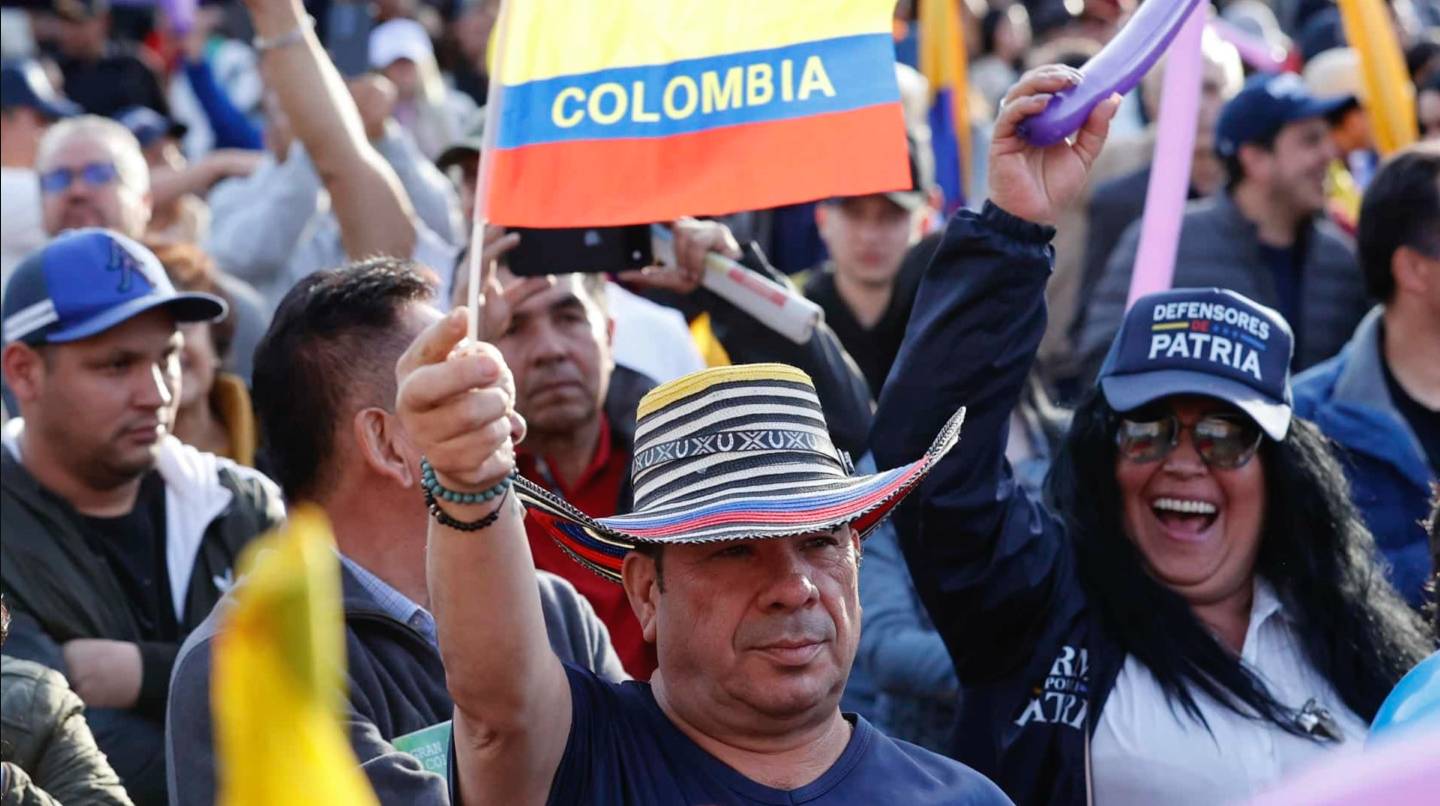
Last Sunday, the first round of the presidential election was held, and Colombians were left in shock. In just three weeks, on June 21, the runoff election will pit the two ends of the ideological spectrum against one another in a country facing severe—and dangerous—political polarization, alongside a worsening internal security situation. On one side stands the candidate furthest to the left, Iván Cepeda; on the other, the candidate furthest to the right, Abelardo de la Espriella.
The result came as a complete surprise. While those on the left had taken Cepeda’s first-round victory for granted (he won 43.7% of the vote), the opposition camp believed that Paloma Valencia, the candidate of the Democratic Center party (who obtained 6.9%), led by former president Álvaro Uribe Vélez, would be the one challenging for the presidency in the runoff. Both sides misread the outcome. Abelardo de la Espriella, of the Defenders of the Homeland party, also secured 43.7%.

An optimistic reading and a pessimistic reading
There are two possible interpretations of what the election results could mean for the country. On the one hand, an optimistic reading suggests that, given Colombia’s electoral tradition, this polarization will not have a devastating impact. On the other hand, a pessimistic reading warns that the country could suffer serious consequences for its democratic stability.
Regarding the optimistic view, it is important to remember that since the end of the only military governments Colombia experienced in the twentieth century—those of Gustavo Rojas Pinilla and the Military Government Junta between 1953 and 1958—the country has had fifteen presidents over the course of 68 years. This represents an exceptional record of civilian stability within the Latin American context. Even Gustavo Petro, the first left-wing president in Colombia’s history, took office on August 7, 2022, without incident. This contrasts sharply with the storming of the Capitol in Washington on January 6, 2021, by supporters of Donald Trump angered by Joe Biden’s victory, or the invasion of the Plaza of the Three Powers in Brasília on January 8, 2023, by supporters of Jair Bolsonaro dissatisfied with the victory of Luiz Inácio Lula da Silva.
This political tradition should be a source of reassurance. However, there was one election that did trigger a serious national crisis. In 1970, following the electoral victory of Misael Pastrana Borrero, supporters of General Gustavo Rojas Pinilla—who campaigned with a populist message—claimed that electoral fraud had occurred. They took to the streets, and President Carlos Lleras Restrepo declared a state of siege. Shortly thereafter, in reaction to that alleged fraud, the M-19 emerged—the guerrilla group in which Gustavo Petro would later become a member.
Does today’s climate of polarization resemble that of 1970, the only election in which the country’s democratic stability was genuinely at risk? Are we once again going to irresponsibly revive the specter of electoral fraud?
Without a doubt, we must weigh, on the one hand, Colombia’s long tradition of elected civilian governments, the separation of powers, and the independence of the judiciary, and on the other, the profound political polarization of the present. From there, we must try to determine which force will ultimately carry greater weight.
Is extreme political polarization inevitable?
Following the announcement of the election results by the official authorities, a climate of tension emerged that has generated considerable concern. On the one hand, President Petro irresponsibly cast doubt on the transparency of the electoral process, a message later echoed by his party’s candidate, Iván Cepeda. On the other hand, both Cepeda and, later, Abelardo de la Espriella delivered inflammatory speeches after learning that they would face one another in the runoff, embracing a friend-versus-enemy logic.
These polarizing narratives, combined with the extreme fragmentation of the party system—which has fostered a highly personalized form of political leadership lacking effective checks and balances—and the deterioration of public order at the hands of both politically motivated and criminal armed actors, could prove explosive. We must never forget El Bogotazo of April 9, 1948.
For this reason, public opinion must mobilize and demand restraint from both candidates in their use of language. Under no circumstances—and especially not in the country’s current situation—is hate-filled rhetoric responsible. At the same time, it is essential that we build what the assassinated Conservative leader Álvaro Gómez Hurtado once called “agreements on the fundamentals”: a shared commitment to respecting the 1991 Constitution, the rule of law, and the separation of powers; recognizing electoral results; and accepting the legitimacy of the winner of the democratic process.
Autor

Professor at the National University of Colombia. Former president of the National Commission for Reparation and Reconciliation (CNRR) and member of the Board of Directors of the Victims Fund of the International Criminal Court.