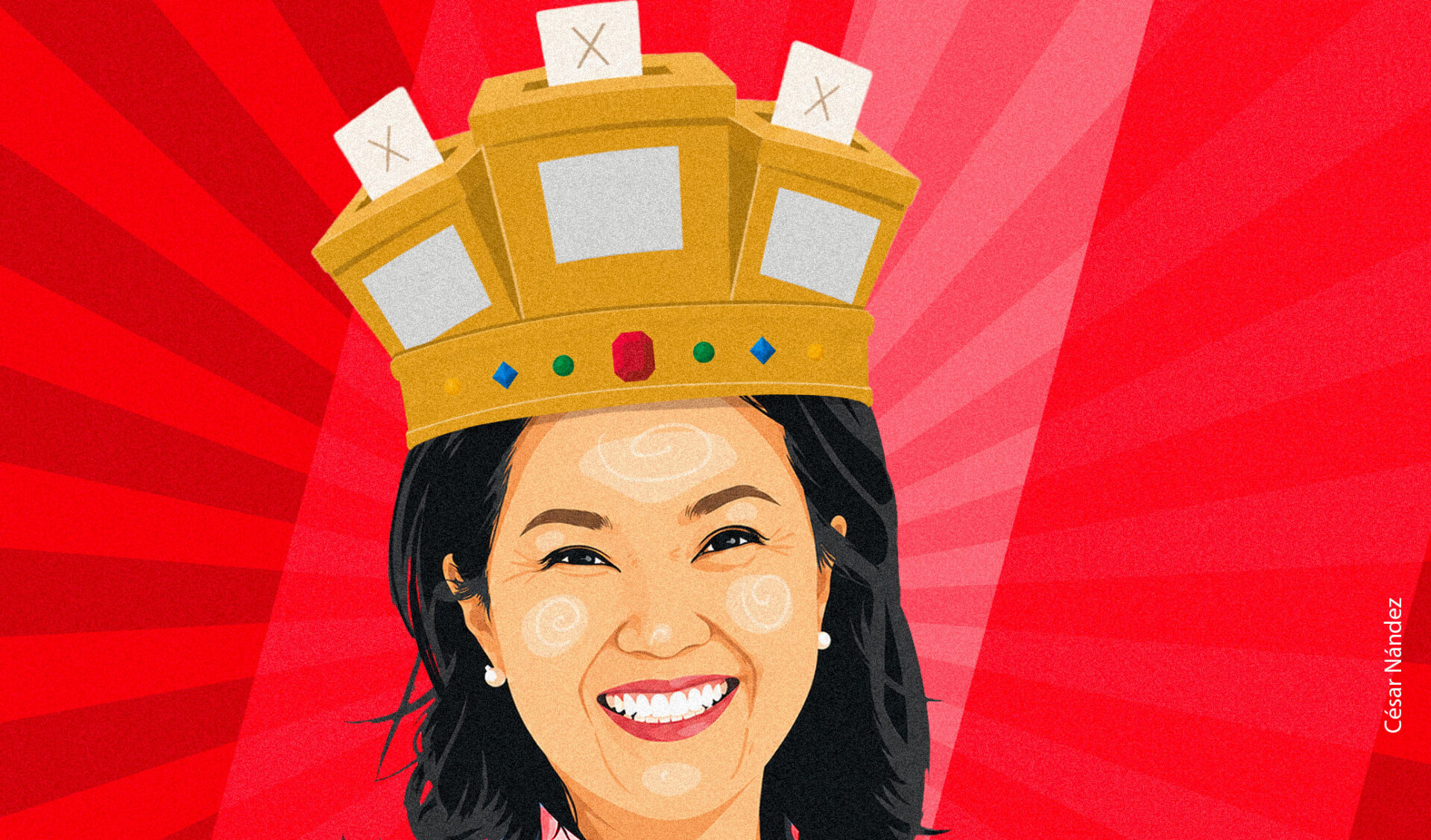
The shadow of her father no longer covers her. Keiko is facing Peru’s presidential runoff for the fourth time, but for the first time without her father alive: former president (1990–2000) and gravedigger of Peruvian democracy, Alberto Fujimori. In the general elections of April 12, the conservative leader of the Popular Force party won 17% of the vote, 5 percentage points more than the runner-up, center-left candidate Roberto Sánchez of Together for Peru. Perhaps the most polarizing political figure in the country, Keiko will seek to persuade Peruvians in the June 7 runoff that, after so many failed presidential experiments, they might now value her political experience. If she wins, she would join the recent trend of electing conservative governments in neighboring Ecuador, Bolivia, and Chile.
The Peruvian electoral context has changed dramatically since Keiko first ran for president in 2011 at just 36 years old, although she had already served as first lady between 1994 and 2000 and as a congresswoman from 2006 to 2011.

Destiny?
Keiko’s image may be enhanced this time because she could represent experience and stability in a context where clashes between the executive and legislative branches have led to successive presidential replacements through impeachments, votes of no confidence, and resignations. Frequent presidential corruption scandals and the institutional weakness of parties in a highly fragmented Congress have sustained a cycle of instability, in which eight presidents have played musical chairs at the Government Palace since 2018.
Pedro Pablo Kuczynski, who narrowly defeated Keiko in the 2016 election, resigned in March 2018 in anticipation of being removed by Congress amid corruption allegations. The legislature then approved the removal of Kuczynski’s successor, Martín Vizcarra, in 2020 for “permanent moral incapacity.” His successor, Manuel Merino, lasted less than a Lima sigh, resigning after just five days in office due to massive protests against him. Francisco Sagasti then managed to survive for eight months and complete Kuczynski’s constitutional term (2016–2021). Keiko returned to the race in 2021, but lost the runoff to the then little-known Pedro Castillo. Castillo soon unraveled, however, when Congress removed him in 2022 following a failed self-coup attempt. He was followed unsuccessfully by Dina Boluarte (2022–2025) and José Jeri (2025–2026), both removed by Congress. Fujimori or Sánchez will succeed José María Balcázar, who assumed office in February of this year.
Keiko has weak democratic credentials. She still proudly honors her dictator father, has used her legislative influence to obstruct the executive branch, has alleged electoral fraud in her defeats without solid evidence, and has faced legal charges related to money laundering and criminal organization. Yet politically, she has maintained strong leadership over time and has also proven capable of navigating difficult situations, even within Fujimorismo itself.
Regardless of the outcome, Keiko embodies two effective pathways to political power in Latin America: dynastic inheritance and the rise of former first ladies as successful politicians. She illustrates how informal networks and family ties perpetuate dynastic power in fragile democracies with weak parties. Peru has numerous small, weakly institutionalized parties. In that context, voters turn to name recognition as a shortcut: surnames replace platforms, and personalities outweigh ideology. Dynastic ties provide a ready-made political base.
Dynasty
Alberto introduced Keiko to politics when he appointed her first lady of Peru at just 19 years old. The appointment came after Fujimori’s divorce from Susana Higuchi, who accused him of ordering intelligence agents to torture her. Keiko held the position until her father fled to Japan in 2000 to avoid corruption charges.
Once Alberto left Peru, Keiko inherited the leadership of Fujimorismo, the right-wing populist movement built around her father and embodied in the Popular Force party, which she has led since its creation.
Keiko has built her career closely tied to her father’s image. On election day, she visited her parents’ graves before voting as a clear signal of continuity. Within Fujimorismo, she clashed with her brother Kenji, one of the most-voted members of Congress between 2011 and 2018, who broke with Popular Force to prevent Kuczynski’s impeachment. In retaliation for his rebellion, Popular Force released videos that appeared to show Kenji buying votes, leading to the collapse of his political career. Other members of the Fujimori family have also served in the legislature, including Susana Higuchi (2000–2006) and Alberto’s brother Santiago (2006–2011). Together, they have consolidated the Fujimoris as Peru’s most influential political dynasty.
Dynasties are not uncommon in Latin America. In Colombia, two Pastranas and two members of the López family became presidents a generation apart. Uruguay had four Batlles across two generations. Guatemala’s president, Bernardo Arévalo, is the son of former president Juan José Arévalo. In Venezuela, acting president Delcy Rodríguez heads the executive branch while her brother Jorge presides over the National Assembly.
This trend has recently expanded to former first ladies such as Keiko. Our research shows that between 1999 and 2026, twenty former first ladies ran for public office 34 times in Latin America and were elected on 23 occasions. Twelve of those candidacies occurred in the last ten years alone. When former first ladies run for Congress, they always win: 14 attempts, 14 victories, including Keiko.
The emergence of first ladies as candidates should not surprise us. They often serve as the president’s closest advisers, with access to information that never reaches the cabinet. They influence public policy, represent the state in international forums, and coordinate actions among ministries, all without holding elected office or facing formal oversight. The role of first lady provides visibility and access to decision-making without accountability. These advantages lower barriers for members of dynastic families while raising them for everyone else, restricting representation and pushing democracy toward a form of soft patrimonialism.
In a study of 88 first ladies across 18 Latin American countries between 1990 and 2016, we found that 75% participated in the design, direction, or administration of public programs. The presidency has proven more difficult, with only 3 victories in 11 attempts. Cristina Fernández achieved it twice in Argentina, and Honduras’s Xiomara Castro was the most recent to win, in 2021. Keiko could be next.
Autor

Assistant Professor of Political Science at Carnegie Mellon University. Specialized in presidential behavior and the comparative study of political institutions in Latin America. More information at www.ignacioarana.org

PhD in Political Science. Associate Researcher at the GIGA Institute for Latin American Studies in Germany and a member of the Network of Political Scientists.