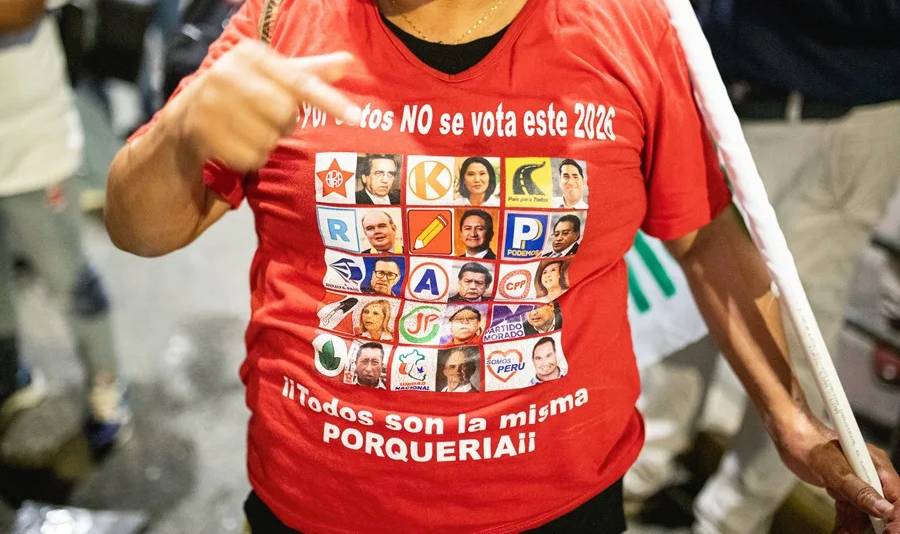
The June 7 runoff election will determine who becomes Peru’s next president. The first-round results once again confirmed the country’s political fragmentation. Keiko Fujimori won 17.19% of the vote, while Roberto Sánchez secured 12.03%. Both advance to the second round with a limited electoral base, jointly representing only around 18% of the national electorate, which consists of more than 27 million eligible voters. The legality of the outcome is not in question; what remains debatable is the social depth of the representation emerging from such an election.
Yet the result should not be interpreted as a complete surprise. Polls failed to capture Roberto Sánchez’s rise. Since mid-January, social media had already revealed significant mobilization among rural sectors, particularly through a visual identity directly associated with the experience of Pedro Castillo: the wide-brimmed, high-crowned hat as a political, social, and territorial symbol. There was therefore no repeat of the surprise factor seen in the previous election. Rather, what occurred was the inability of polling firms and certain analysts to look beyond Lima and their own assumptions.

The initial methodological problem of several surveys was treating undecided voters as a residual category. Undecided voters are often considered statistically insignificant or lacking analytical value, when in reality they are central to understanding electoral behavior in both polarized and non-polarized societies. From a qualitative perspective, surveys rarely ask about fears, rejections, territorial identities, perceptions of household economic conditions, political memories, or expectations regarding order and stability. Research tends to focus on the candidates who finance the studies rather than on the voters themselves. The undecided voter is not someone who “doesn’t know,” but rather an elector evaluating options within a highly discredited political system.
Despite these shortcomings, some electoral rules held true. Well-known candidates had a greater chance of attracting votes than unknown ones. The former needed only to persuade voters, while the latter faced a double challenge: first becoming known and then becoming appealing. This explains the strategic intelligence behind Roberto Sánchez’s decision to link his candidacy to a recognizable social identity in the rural and Andean world. It was not merely a policy message but a symbolic operation in territory where few others dared to compete.
The political right entered the race fragmented. Rafael López Aliaga finished in third place, very close to Sánchez. However, López Aliaga ran an aggressive and often coarse campaign, reminiscent in tone of those of Javier Milei and Jair Bolsonaro, and out of sync with the preferences of most Peruvian voters. His Christian moralist discourse failed to resonate with an electorate that is no longer primarily mobilized along those lines. In other words, he was unable to connect with the country as a whole because he spoke through a political grammar that was more ideological than material. In a nation where insecurity, precarious employment, and economic hardship outweigh imported culture wars, excessive moral crusading tends to become detached from everyday realities.
It would be a mistake to interpret López Aliaga’s support solely as an expression of ideological conservatism. His vote should be understood primarily through the lens of Lima. In areas where municipal investment was most visible—roads, transportation infrastructure, urban maintenance, and public works—many voters may have interpreted these projects as signs of employment, stability, or at least inclusive economic activity. Consequently, support for López Aliaga in Lima can be read as approval of his performance in office rather than simply as a conservative vote.
This logic differs from that of Fujimorismo. In Keiko Fujimori’s case, support is explained more by the persistence of a political memory associated with order, security, anti-left sentiment, party networks, and a highly recognizable electoral brand. It is not a vote primarily dependent on recent public investment but rather on a political identity deeply rooted across multiple regions. By contrast, support for López Aliaga appears more closely linked to perceptions of concrete governance in the capital.
What the polls say
The latest Ipsos poll confirms that the runoff remains open. Keiko Fujimori registers 39% support, while Roberto Sánchez stands at 35%. Blank or spoiled ballots account for 14%, and 12% of respondents remain undecided. In other words, 26% of the electorate is not clearly aligned with either candidate.
This figure is more important than Keiko’s slight initial lead. It shows that the election still depends on voters who remain unconvinced and are effectively choosing between candidates who were not their first preference. Since 2001, Peruvians have repeatedly voted for what they perceive as the lesser evil. Ipsos also reports that crime and corruption are the issues most frequently identified by citizens as the country’s principal problems, with 63% and 62%, respectively. This helps explain why the election is not defined solely by a left-right divide, but by concerns about order, security, stability, and dissatisfaction with the political system.
Some commentators have attempted to explain the result through the absence of professional politicians, a supposed resurgence of the left, or an alleged shift of the Peruvian electorate toward the center-right. These interpretations are mistaken because they analyze the election primarily from the perspective of the capital and underestimate the rest of the country. Peru did not vote according to ideological doctrine. Nor did voters cast ballots as if they were following political science textbooks. They voted based on territories, fears, memories, precarious jobs, exclusion, visible public works, accumulated frustrations, postponed demands, and minimal expectations of order. Voting behavior also contains a structural component linked to the neoliberal model.
In this regard, it is worth recalling that V. O. Key Jr., in his classic 1966 work The Responsible Electorate, argued that voters make decisions based on reasonable evaluations of the political world and public policies. They are not irrational masses driven solely by manipulation or ignorance. They can certainly make mistakes, just as analysts do. But their decisions respond to signals, experiences, and calculations that make sense within their social reality.
The first-round result cannot be explained by a confused electorate. Nor will the June 7 election be merely a contest between two candidates. It will be a struggle to impose, however temporarily, some form of order on a country whose political system is sustained and reproduced through fragile representation. Peruvian voters are not lost. They are reading the country with the tools available to them. The problem is that many of those interpreting them continue to analyze Peru from a distance.
Machine translation, proofread by Ricardo Aceves.
Autor

Cientista Político. Profesor e investigador asociado de la Universidad Federal de Goiás (Brasil). Doctor en Sociología por la Univ. de Brasilia (UnB). Postdoctorado en la Univ. de LUISS (Italia). Especializado en estudios comparados sobre América Latina.