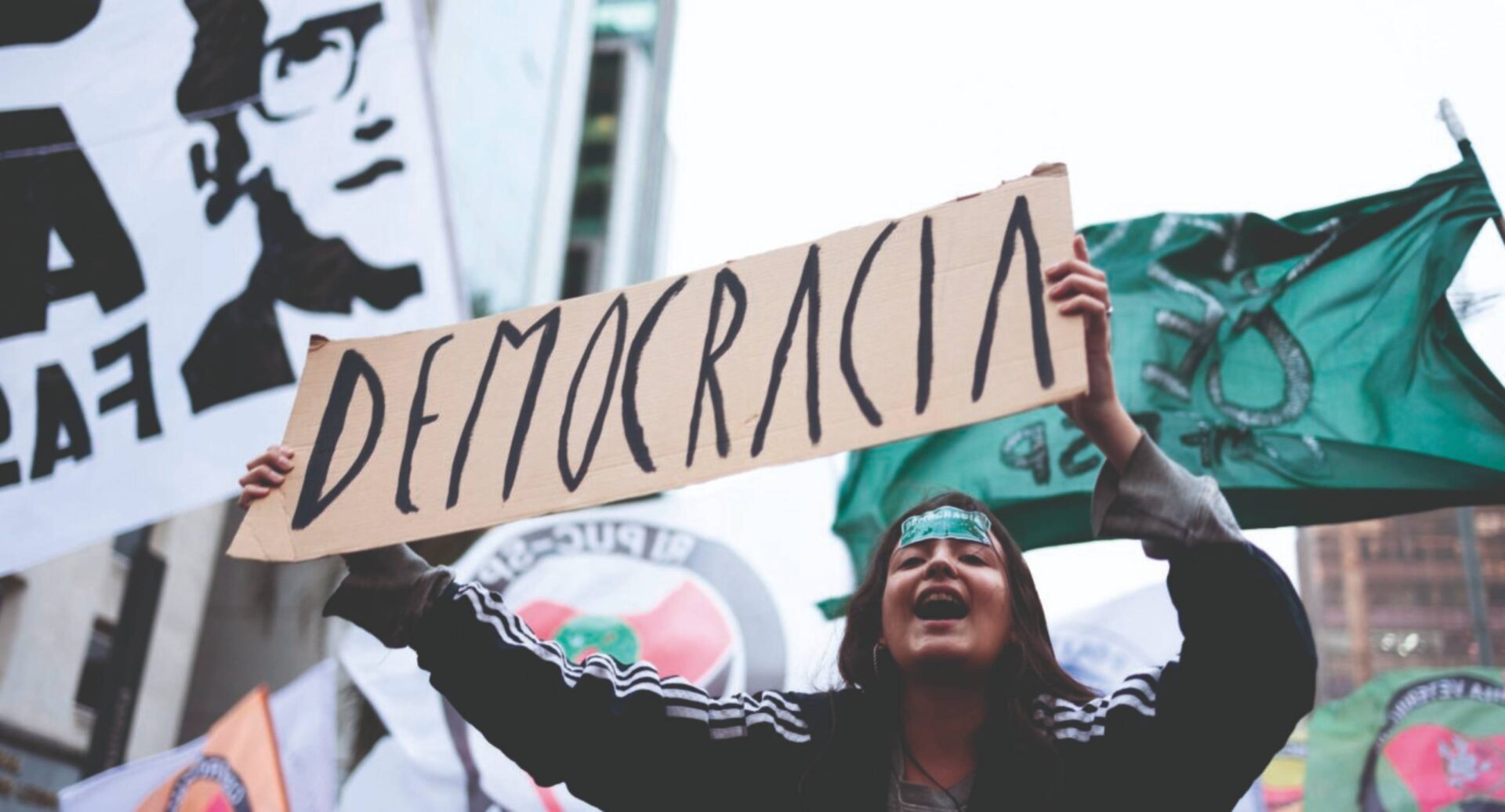
In the heat of recent electoral contests, accusations have proliferated among candidates that their opponents are undermining democracy. At the same time, several alarming reports on the state of democracy in Latin America have appeared in recent weeks. This remarkable coincidence seems to be a clear indication of growing concern over democratic governance in the region.
The United Nations Development Programme (UNDP) has just released a comprehensive report on democracy and development in the region, with the telling title Democracies Under Pressure. In its foreword, the report notes that current tensions “are unfolding in a context in which democracies face new and interconnected pressures. Political polarization has intensified. Organized crime and illicit economies have expanded their influence in some contexts. Digital platforms and artificial intelligence are transforming the public sphere and the way people participate in political life.”

At the same time, a special issue on governance conditions in Latin America has been published by the Spanish journal Tiempo de Paz, led by Paquita Sauquillo and Carlos F. Liesa. The publication reviews the structural and contextual trends that shape the foundations of democratic governance in the region. Alongside analyses of the economic situation, security and violence, and increasing migration flows, Marcela Ríos—International IDEA’s representative for Latin America and former Minister of Justice of Chile—examines the state of democracy in the region, caught between resilience and disenchantment.
Both publications share a concern about the crossroads at which democracy in Latin America currently stands, although they differ somewhat in their approach. The UNDP report states that it “revisits the notion of a ‘democracy of citizens’ proposed by the UNDP report in 2004,” but adds that it “incorporates the role of the State as a key mediator between democracy and human development.” This emphasis on the central role of the state shifts the focus of the 2004 report, which argued that the main key lay in what it called “the creation of citizenship.”
This difference in perspective is reflected in several of the articles and in the introduction to Tiempo de Paz’s special issue on Latin America. At the heart of this divergence lies the way democracy is valued. Democracy has a dual value. One is instrumental in nature, whereby democracy is judged according to the public goods it helps provide—employment, education, healthcare, and so forth. The other is substantive, understanding democracy as a political system that enables collective decisions to be reached peacefully. When democracy’s instrumental value is prioritized, support for it becomes conditional on broader structural trends, such as global economic crises. By contrast, when democracy’s substantive value is clearly perceived, support for it is more likely to be maintained regardless of circumstances.
During the process that led to the 2004 democracy report, this dual conception was captured in a statement that achieved broad consensus: “The quality of democracy depends not only on the quality of institutions, but also on the quality of citizenship” (or, put differently, on the quality of citizens’ political culture). For this reason, the 2004 report considered the creation of citizenship essential for consolidating a democracy of citizens.
In fact, the 2004 report already revealed a difference in sensitivities between those who viewed the state as the cornerstone of democratic development and those who believed the key lay in the political culture of citizens. It appears that, in the 2026 UNDP report, advocates of placing greater emphasis on the state have returned in order to “reimagine the futures of democracy.” Some may regard this as a necessary correction, while others may see it as a step backward from the idea of a democracy of citizens, which has been widely praised since 2004.
As the Tiempo de Paz special issue makes clear, however, this is a false dilemma. There seems to be no need to choose between having strong and effective states and contributing to the effort of building citizenship through a political culture that recognizes the substantive value of democracy.
Autor

Enrique Gomáriz Moraga has been researcher at FLACSO in Chile and other countries in the region. He was a consultant for international agencies (UNDP, IDRC, IDB). He studied Political Sociology at the Univ. of Leeds (England) wit R. Miliband.