A month is a period that may seem long, but in politics it is usually an eternity. It is a period in which events take place that deserve greater attention, although it can also consist of four long weeks in which apparently nothing happens. In the vicissitudes that dominate Latin American politics in its international domain and more specifically in the sphere of its always relevant hemispheric relations, there have been two moments that catch my attention and deserve special monitoring since, moreover, they are framed by the speech given by a relevant political official.
The first moment has to do with the fact that, according to the New York Times, the United States is sending a battalion of 600 soldiers who are deploying to a new training center in the jungle of Panama and who will subsequently train with forces from Colombia and Honduras. This would represent the largest US military contingent in decades in a region where its presence has not ceased to have traumatic effects. This could constitute the culmination of thirteen months of US airstrikes against ships of alleged drug traffickers that have brought with them more than two hundred fatalities.

This is yet another episode in the war on drugs unleashed more than half a century ago with the all too familiar discouraging results. At present, it is observed that cocaine trafficking has been diverted without being halted, as traffickers constantly devise different mechanisms, such as attaching modules loaded with cocaine to the hulls of freighters and transporting shipments along increasingly convoluted routes. Narcotics reach the United States and Europe in record quantities at lower prices and, in the case of cocaine, with higher purity than in decades, with wholesale prices that, although they have fallen, reach around $16,500 per kilogram in Miami.
The second moment features the process of selecting the person who will take charge of the UN Secretariat-General starting next January 1. A basic institution in the framework of today’s discredited multilateralism, which the current Argentine president described at its own headquarters just a few weeks ago as a “useless organization” that maintains a caste of “arrogant parasites.” The non-explicit veto by the United States against the position being occupied by a Latin American woman, faithful to the current ideology of the White House, has been projected through its influence on governments integrated into the Shield of the Americas.
If the Chilean president already unseated the candidacy of his compatriot Michelle Bachelet, now it was the president of Costa Rica who unusually dismissed her Minister of Foreign Affairs for running, as was his duty, an overly committed campaign in favor of his compatriot Rebeca Grynspan. The evidence of alignment between Santiago and San José with Washington serving the ultimate interests of the latter and without taking into consideration the general interests of their respective countries is clear.
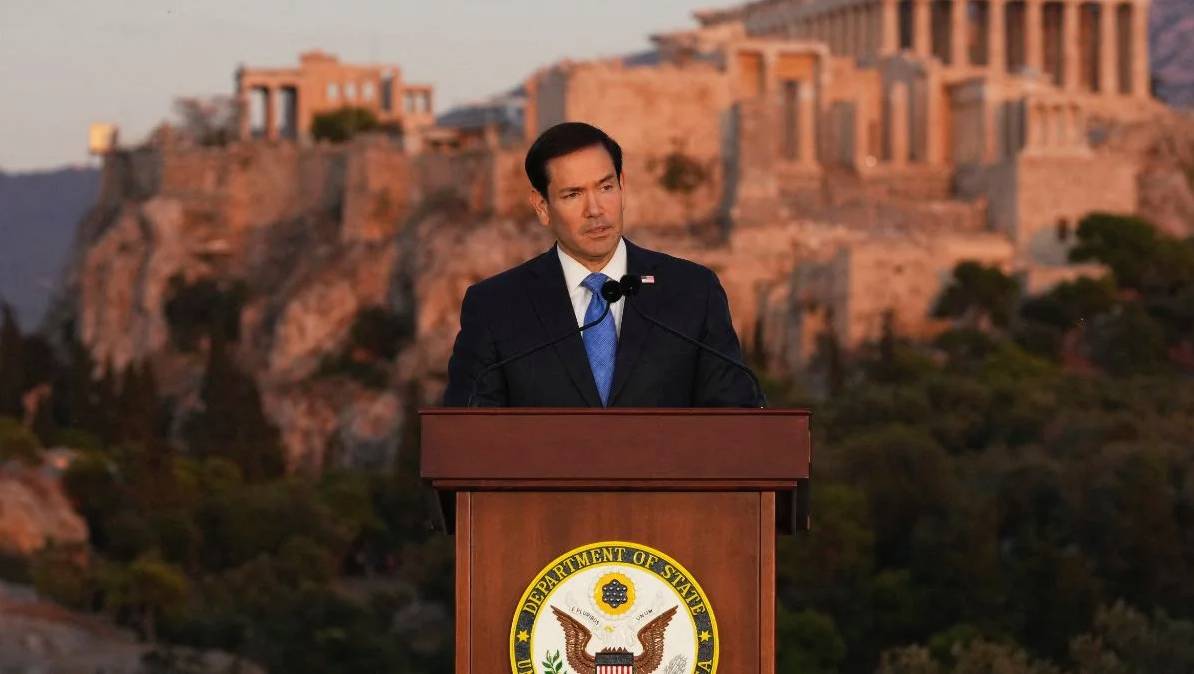
Both moments acquire special significance in light of the speech delivered by the US Secretary of State before the Acropolis on October 7, where he presented himself as a “great-grandson of settlers who came from Spain to the New World.” Although the purpose of his words was to present the doctrine of a new Occidentalism, the semantic use of the term “settler” instead of “emigrant” was nonetheless relevant so as not to violate the anti-emigrant demonization discourse so in vogue today.
The need to support unlimited power and to justify the process of recolonization required a physical framework of that nature where they could be praised. In this way, “the qualities that led Alexander to conquer the entire known world reappeared in Caesar, then in Charlemagne and in Cortés,” in the words of the Secretary of State, driving a type of new manifest destiny. To this end, what must now be done is to “conquer new frontiers: in cutting-edge manufacturing and superintelligence; in drones, weapons, and warfare; in chips, minerals, cybersecurity, and all other realms of the humanly possible. Release our energy, rebuild our factories, send our astronauts back to the Moon, and open a new era of space exploration.”
The refoundational character of his proposal required the emblematic framework of the Parthenon for the image to go viral and to utter a statement of unequivocal imperial character: “the history of our civilization is the grandest humanity has ever known.” The speech, in the media circus in which we live, not only aims to fully justify the two moments cited above, but also articulates arguments in favor of a return to the stage of solid modernity prior to the major changes that began to occur after World War II. The vindication of his Spanish ancestors and the inclusion of Hernán Cortés, aligned with Caesar and Charlemagne, represent a confrontation on the theoretical plane—though with the obvious practical consequences already referred to—with postcolonial preaching.
A proclamation to settle a political order that requires not only labels like MAGA—Make America Great Again—but a florid narrative in which the origin of the name of Philadelphia or the fact that the most cited author in The Federalist Papers is Plutarch is claimed. But also indomitable individuality and tireless ambition, among other traits. In short, a boastfully erudite speech that accompanies two moments of a different nature but of overlapping significance to settle the start of a presidential race, perhaps, or a toast to the sun within the framework of the prevailing technofeudalism that can devour everything.
Autor

Director of CIEPS - International Center for Political and Social Studies, AIP-Panama. Honorary Emeritus Professor at the University of Salamanca and UPB (Medellín). Latest books: "El oficio de politico" (Tecnos Madrid, 2020), "Huellas de la Democracy Fatigada" (Océano Atlántico Editores, 2024) and "Cuando la política dejó de ser lo que era" (Océano Atlántico Editores, 2025).