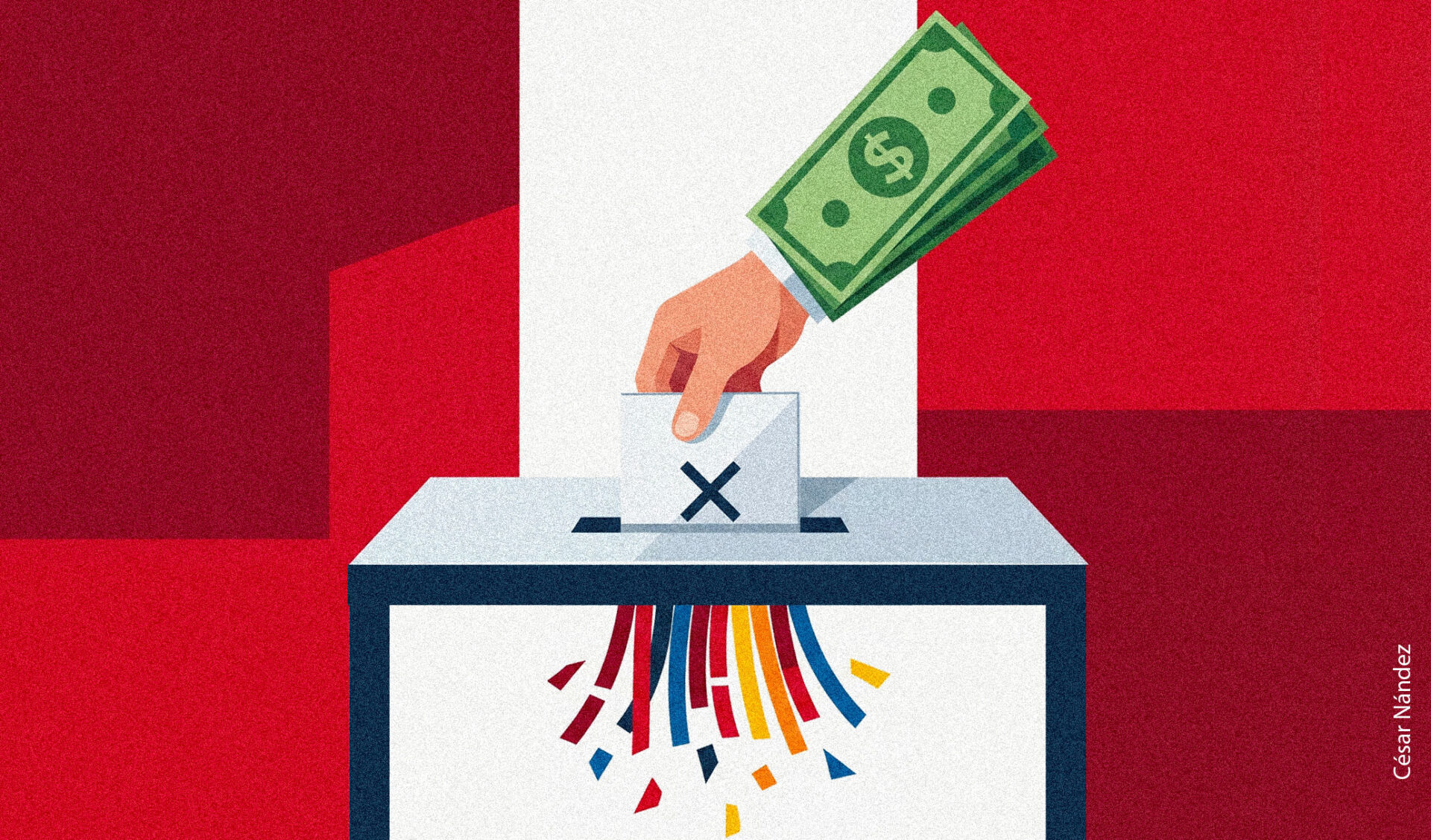
On Sunday, April 12, Peruvians will head to the polls with little enthusiasm to elect a new president. But this election does not seem to open a dialogue with the future; rather, it exposes the precariousness of Peru’s current political landscape. In recent decades, Peruvian politics has been marked by persistent instability, featuring former presidents imprisoned, one who committed suicide, and others removed from office before completing their terms. In this context, the question is no longer just who will win the election, but what structural conditions explain why holding the presidency in Peru seems, time and again, to lead to discredit, punishment, or downfall. So then, does politics matter?
Thirty-five candidates will compete for the Peruvian presidency, reflecting a high degree of political fragmentation. This figure represents one of the most complex contests in the country’s history, as it seeks successors for the 2026–2031 term. Of course, the number of candidates is not the causal factor itself, but rather the dispersion of preferences that shapes fragmentation, which cannot be explained by a single cause but by the convergence of multiple factors: from permissive electoral rules that have made it easy to register parties, to an electoral system centered on candidates (preferential voting), which has fragmented especially the less institutionalized, less programmatic, and less disciplined parties.

To these institutional rules is added social heterogeneity—identity and ethnic dimensions, as well as the urban-rural divide—and territorial factors. In the latter case, the decentralization process, in which each region seeks representation based on its own movements and political machines, has led to a disconnect from national platforms that are organized without social density or territorial reach.
This is compounded by a crisis of representation, where parties steadily lose legitimacy due to weak governance and a deficit of credibility, opening space for new anti-establishment organizations and movements. This dynamic is reinforced by the media system—formerly television and now social media—which facilitates more personalistic candidacies, less dependent on party structures, thereby fostering fragmentation and rendering programmatic issues increasingly invisible.
One of the causes of fragmentation lies in the economy, as neoliberalism contributes to fragmentation, particularly when it disrupts the social bases of representation, blurs programmatic differences between parties, and leads to a war of “elimination” of the opponent. Political scientist Kenneth Roberts illustrates how this mechanism works. First, neoliberalism breaks the historical links between parties and society. When a party representing the working class, popular sectors, or organized middle classes implements market reforms that harm its own base, that bond erodes.
In Peru, the collapse of the party system in the 1990s persisted even after the fall of the authoritarian regime in 2000, with the continuation of the 1993 Constitution. Parties that were once programmatically distinct converged in ways that erased party identities and generated ongoing programmatic dealignment.
It is not only that centrist or center-left candidacies promised one thing and governed by doing another—such as Alejandro Toledo, Ollanta Humala, or Alan García, who implemented or maintained neoliberal reforms—but also that party offerings failed to differentiate themselves clearly, reinforcing the perception that “they are all the same.”
A third mechanism is the colonization of life through precariousness, inequality, and frustration. When more institutionalized parties fail to channel this discontent, alternatives emerge outside the system, whether as outsiders or not (as occurred with Pedro Pablo Kuczynski and Pedro Castillo). In this way, the institutional precariousness of politics ends up sustaining the reproduction of the economic model, which is why the economy remains detached from politics.
Development models do not only produce socioeconomic effects; there is no real dissociation, even if different academic fields insist that there is significant distance. The connection lies in how economic policies define the political agenda, shape representation, and determine the programmatic content of partisan competition. In comparative terms, there is an association between inclusive, universalist development models and lower levels of party fragmentation. By contrast, less inclusive or neoliberal models—those that tend to obscure programmatic content and promote convergence—erode social ties, weaken party identities, and make representation more unstable.
This is why Peru has become the standard-bearer of neoliberalism in Latin America—a model to follow—since precariousness operates as a kind of virtuous circle that keeps the economy insulated from political and social consequences. Perhaps Keiko Fujimori, who appears likely to reach the runoff, could, if elected, experience the poison her father injected through the institutional precarization of Peru’s political and social system. And if the winner is an opponent of the neoliberal economic model, they will be cast out under the same Gramscian-type neoliberal hegemony that prevails in Peru.
Autor

Cientista Político. Profesor e investigador asociado de la Universidad Federal de Goiás (Brasil). Doctor en Sociología por la Univ. de Brasilia (UnB). Postdoctorado en la Univ. de LUISS (Italia). Especializado en estudios comparados sobre América Latina.