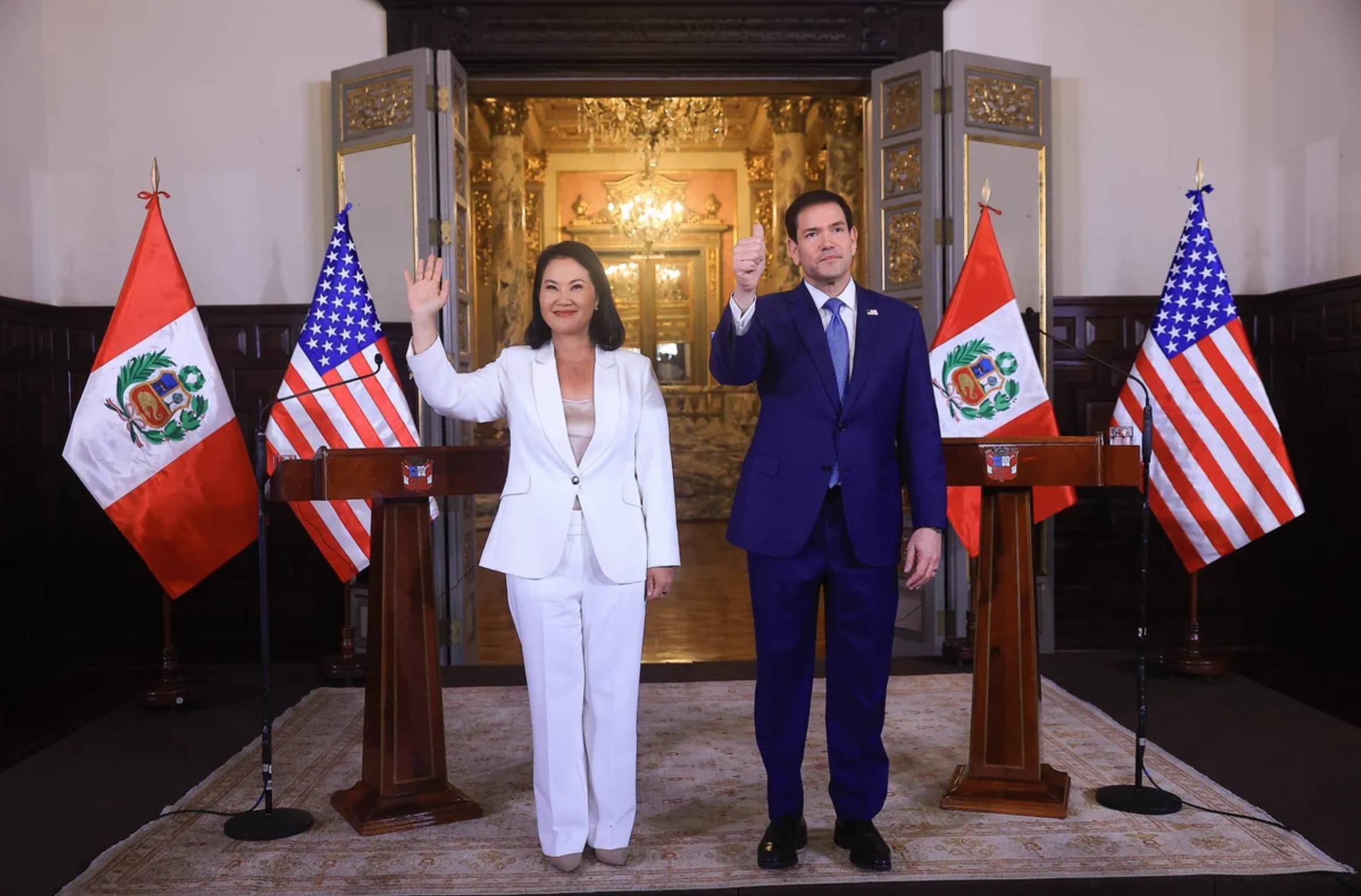
Marco Rubio recently concluded in Lima a lightning tour of South America—with previous stops in Bogotá and Quito—formally bringing Peru into the “Shield of the Americas,” the regional security coalition promoted by Washington to combat drug trafficking and organized crime. It is a photograph that represents a new hemispheric alignment: conservative President Keiko Fujimori, just weeks after taking office, sealing her first major international agreement with the United States.
But behind the photo are two figures that should be considered. The first: Fujimori won the presidency by just 49,641 votes, one of the narrowest margins in Peruvian electoral history. The second: fifteen of the nineteen ministers in her cabinet face investigations, have been involved in previous proceedings, or have criminal records. Certainly, Washington has weighty geostrategic reasons for moving closer to Lima at this new political juncture. But the solidity of this rapprochement depends less on what the United States decides than on the governability that Peru’s new government can sustain.

The attraction is real. Peru holds lithium, copper, and a port (Chancay) built with Chinese capital that already operates as a logistics hub for the South Pacific. At a time when Washington is seeking to diversify supply chains and reduce its dependence on Chinese critical minerals, Lima offers a solid alternative at a shorter distance. Added to this is the regional security agenda: the State Department sent a high-level delegation to Fujimori’s inauguration, led by Under Secretary Christopher Landau, and announced greater support in the fight against transnational organized crime, including the ELN, Los Choneros, the Tren de Aragua, among other organizations designated as terrorist groups by the Trump administration.
But what does Peru really gain, and how much room for maneuver does a government without its own majority in Congress have? The so-called “Trump Corollary,” beyond its implications for U.S. regional policy and national security, is neither an orderly nor a predictable roadmap. Disagreements within and outside Washington’s political circles, including sectors of the Republican Party itself, raise questions about whether militarizing the fight against drugs in the region truly serves U.S. long-term interests, beyond its symbolic effect.
For Lima, meanwhile, this means negotiating with a power whose priorities can change from one quarter to the next, something Peru already experienced in April 2025, when tariffs of up to 50% hit copper exports before being partially reversed months later.
This is not a new problem. Since 1990, the relationship between Washington and Lima has gone through three stages: the rise and fall of Alberto Fujimori, marked by the defeat of the Shining Path but also by the 1992 self-coup and the corruption of Vladimiro Montesinos; a phase of trade liberalization and fiscal discipline between 2001 and 2016, culminating in the Free Trade Agreement signed in 2009; and the last decade, that of the “presidents without parliament.” A precursor to the period of greatest instability in its recent history. In ten years, Peru has had nine heads of state.
That is the real obstacle to any “window of opportunity” that Washington might seek to pursue: not political will, which exists in both capitals, but Peru’s persistent institutional fragility. A fragmented Congress does not forgive mistakes, and a cabinet with judicial baggage gives the opposition immediate ammunition to question and obstruct any initiative or agreement that entails alignment with Washington.
Added to this is the threat that the Peruvian government itself places at the center of its agenda: organized crime, no longer merely a matter of citizen security, but a direct risk to the country’s governability. This reality, marked by homicides and extortion, has intensified in recent years and is eroding the state’s ability to govern its own territory.
In this context, Washington should avoid two mistakes. The first is to treat its relationship with Peru solely as another piece in its rivalry with China, ignoring China’s strong presence in mining, which is not going to disappear. In fact, the reaction to Rubio’s tour already confirms this: the Chinese Embassy in Lima, without mentioning him by name, warned that the Western Hemisphere “is not anyone’s backyard” and defended the right of Latin American countries to freely choose their partners.
The second mistake is to confuse the regional security architecture with a settled commitment. Although Peru was not among the original signatories of the Shield of the Americas, the coalition Trump launched in March, Rubio formalized its incorporation during this visit. This is a development with real strategic weight for the reshaping of alliances in the hemisphere, not merely a protocol gesture. But joining a coalition does not automatically amount to operational cooperation: questions remain about what the United States’ actual participation will be once the photo-op is over. The confusion over names does not help either: SOUTHCOM’s operational military force in the region, previously known as Southern Spear, was renamed in August as the Western Hemisphere Joint Task Force, a change that reflects just how much this security architecture is being built on the fly.
It is also worth keeping in mind that the agenda of this tour was not limited to security. Rubio urged Lima to prioritize U.S. artificial intelligence technology over Chinese offerings and brought cooperation on the effects of El Niño into the bilateral conversation. These are still modest signals, but they point in a broader direction: a relationship that does not depend exclusively on the fight against drug trafficking and the geopolitics of blocs.
Rubio leaves Lima with the photo he needed: a new conservative ally, joining Bogotá and Quito, the other two destinations on his tour. Fujimori, for her part, is left with the real problem. Peru’s recent history shows that no strategic calculation in Washington can withstand a crisis of governability in Lima for very long. The possibility of a genuine rapprochement exists, and it is now more concrete than it was a month ago. Whether it becomes fully consolidated or not will depend on the political performance of the Fujimori government.
Autor

Politólogo egresado de la Univ. Central de Venezuela y la Universidad Autónoma de Barcelona. Master en Estudios Latinoamericanos, Universidad de Salamanca. Analista de asuntos parlamentarios.